TYPES OF ITR – INCOME TAX FORMS

Income Tax Return is referred to as ITR. Different Income Tax Return (ITR) forms have been provided by the Indian Income Tax Department for different taxpayer categories. Every form is made according to the taxpayer’s category and the type of income. For compliance, accurate tax assessment, and penalty avoidance, it is essential to file the correct ITR form.

An Income Tax Return (ITR) is a form that taxpayers submit to the income tax department stating their earnings and any necessary taxes.

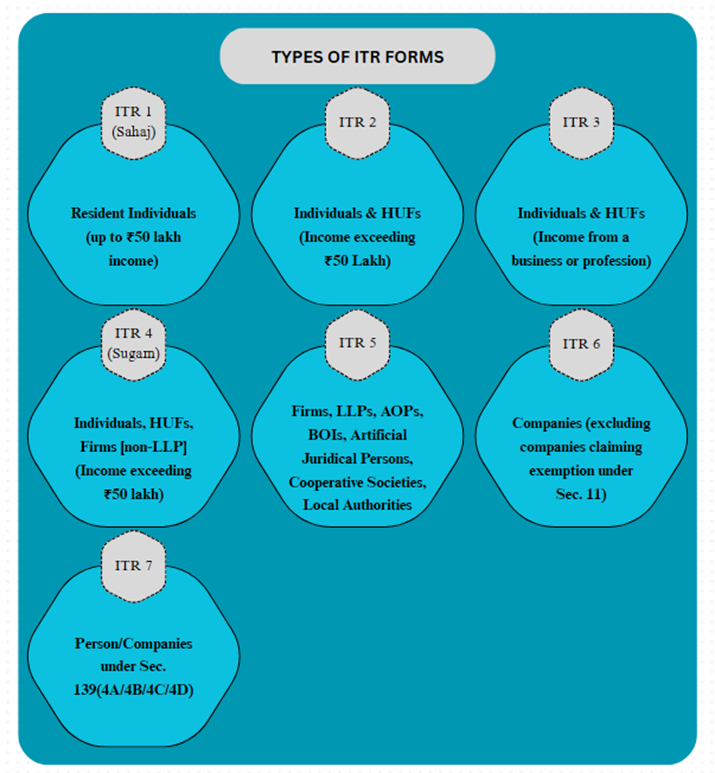
Till now, the department has issued seven forms. It is essential that all taxpayers submit their ITRs before the due date. ITR forms are applicable in many ways depending on the taxpayer’s income sources, income amount, and taxpayer category (individuals, HUF, firm, etc.).
ITR – 1 (SAHAJ)

The ITR-1 has been designed for residents with annual incomes up to ₹50 lakh. It can be applied if sources of income consist of:

  • Pension or salary
  • Income from a single property (unless there is a carried loss)
  • Other sources of income (not include prizes from horse racing or the lottery)
  • Income from agriculture up to ₹5,000
  • Section 112A allows for long-term capital gains of up to ₹1.25 lakh without carrying forward losses

However, anyone with business or professional income, multiple home properties, capital gains that exceed certain restrictions, overseas assets or income, directorship in a corporation, or investments in unlisted equity shares are not permitted to use ITR-1.

ITR – 2

Individuals and HUFs without business or professional income are subject to ITR-2. It works well if your earnings include of:

  • Pension or salary
  • Revenue from residential real estate, including multiple properties
  • Capital gains
  • Foreign assets and income
  • Agricultural earnings that exceed ₹5,000
  • Other sources of income, such as winners from horse racing and the lottery

If you have unlisted equity shares, are a Resident Not Ordinarily Resident (RNOR), are a non-resident, or are a director of the company, you must file an ITR-2. This form is not intended for people who make a living through their profession or company.

ITR – 3

Individuals and HUFs with business or professional income are required to file ITR-3. It includes the following:

  • Private businesses or occupations (where an audit is required or books of accounts are maintained)
  • Income from partnerships (as a partner in a firm)
  • earnings from capital gains, real estate, salaries, and other sources

ITR-3 is the appropriate form to use if your income comes from a proprietary business or occupation that is not subject to presumed taxes.

ITR – 4 (SUGAM)

Individuals, HUFs, and businesses (except from limited liability partnerships) that choose presumptive taxes under Sections 44AD, 44ADA, or 44AE and are residents are subject to ITR-4. It can be applied if:

  • Up to ₹50 lakh is the total income
  • Sections 44AD or 44AE are used to declare business income
  • Section 44ADA’s definition of professional income
  • income from a job, a single residence, or other sources (not including prizes from horse racing or the lottery)

This form is also available to freelancers with gross incomes up to ₹50 lakh. However, if you have income beyond ₹50 lakh, own foreign assets, or are a director of a corporation, you cannot use ITR-4.

ITR – 5

ITR-5 is meant for:

  • Firms
  • LLPs
  • AOPs (Association of Persons)
  • BOIs (Body of Individuals)
  • Artificial Juridical Persons
  • Estate of deceased or insolvent persons
  • Business trusts and investment funds

ITR-5 should be filed by entities that must report income, excluding corporations and trusts.

ITR – 6

Companies are regulated by ITR-6, with the exception of those that assert an exemption under Section 11 (charitable/religious reasons). This return must be submitted electronically by businesses using a digital signature.

ITR – 7

ITR-7 is used by institutions, political parties, trusts, and other organisations that must file returns under:

  • Section 139(4A): Trusts and legal obligations for charitable/religious purposes
  • Section 139(4B): Political parties
  • Section 139(4C): News agencies, scientific research associations, educational and medical institutions
  • Section 139(4D): Universities and colleges
  • Section 139(4E) & (4F): Business trusts and investment funds

WHY SHOULD YOU FILE ITR?

In addition to being required by law, submitting an ITR offers the following benefits:

  • helps in obtaining income tax refunds
  • Necessary for loan and visa applications
  • allows capital or commercial losses to be carried forward
  • serves as evidence of income
  • required for businesses, including those with little profit

CONCLUSION

The type of income, the taxpayer category, and the income level all affect which ITR form is appropriate. Rejection or penalties may follow the submission of an inaccurate form.

Here, this is just a brief about how to know which ITR Form is applicable to you based on your income structure. Consult your Tax consultant before opting for ITR Form or connect with us through

91-9267970588 or taxacumen.consultancy@gmail.com
TYPES OF GST in India – Brief Discussion

Goods and Services Tax (GST) is a form of indirect tax levied on the supply of goods and services in India. This multi-stage tax is at every stage of the supply chain, with the advantage of Input Tax Credit (ITC) at every stage. The current structure is transparent and uniform in taxation across states and avoids the cascading effect of taxes.

The central aim of GST is to support the concept of “One Nation, One Tax” through simplification and streamlining of India’s indirect taxation system.

Central Goods and Services Tax (CGST)

Central Goods and Services Tax (CGST) is imposed by the central government through the CGST Act, 2017. It is payable on all intrastate supplies of goods and services—i.e., where both the supplier and recipient are within the same state or union territory.

CGST is levied with SGST or UTGST on the very same taxable supply. The overall GST rate is divided evenly between the State and the Centre. For instance, if a commodity is taxed at 18%, then 9% is CGST and 9% is SGST. The CGST amount goes into the account of the central government and is utilised for national-level spending such as infrastructure, defence, and centrally sponsored schemes.

The central government allows input tax credits of CGST on acquisitions, which can be utilised to offset CGST or IGST liability but not SGST.

State Goods and Services Tax (SGST)

State Goods and Services Tax (SGST) is charged by the state governments under their respective SGST Acts, which have been enacted in line with the central GST structure. SGST is also charged in intra-state transactions and is levied by the state on which consumption takes place.

The state government involved receives the revenue from SGST. Similar to CGST, the SGST share of a transaction typically accounts for 50% of the overall GST. These revenues are utilised to fund state-level development like education, healthcare, infrastructure, and welfare schemes.

SGST paid as input tax can be utilised to set off SGST or IGST (in certain situations), but not CGST, which assists in keeping the revenues of states and the centre free from mutual dependence.

Illustration: A restaurant business in West Bengal offers services amounting to ₹10,000. If GST is 18%, ₹900 is CGST and ₹900 is SGST.

Union Territory Goods and Services Tax (UTGST)

Union Territory Goods and Services Tax (UTGST) is charged on intra-state supplies made within Union Territories (UTs) that lack legislatures. It is administered under the UTGST Act, 2017, and is payable in the following UTs:

  • Andaman and Nicobar Islands
  • Lakshadweep
  • Chandigarh
  • Dadra and Nagar Haveli and Daman and Diu
  • Ladakh

In such regions, UTGST substitutes for SGST and is charged together with CGST. Both might be collected by the central government, but UTGST is separately credited to an account from CGST.

Similar to what occurs in SGST, the total GST is divided equally—e.g., CGST 9% and UTGST 9% for an 18% GST rate.

Note: UTs having their own legislature, i.e., Delhi, Jammu & Kashmir, and Puducherry, are not covered under UTGST. In such cases, SGST is charged in lieu.

Integrated Goods and Services Tax (IGST)

Integrated Goods and Services Tax (IGST) is charged by the Central Government under the IGST Act, 2017, and is levied on:

  • Inter-state transactions (from one state or UT to another state or UT)
  • Import of goods or services into India
  • Export of Indian goods or services
  • Supply to or by Special Economic Zones (SEZs)

IGST replaces the previous Central Sales Tax (CST) and follows a destination-based taxation system. That is, tax is levied and paid in the state where the goods or services are consumed, rather than where they are manufactured.

In interstate transactions, the seller levies IGST, which is paid to the central government. The Centre then remits the due share to the destination state where the services or goods are ultimately consumed.

Illustration:

A supplier in Maharashtra supplies goods to a customer in Haryana for ₹1,00,000 at 18% GST. The supplier collects ₹18,000 as IGST and remits the same to the Centre. The Centre subsequently adjusts Haryana’s share accordingly.

Yet another advantage of IGST is the cross-utilisation of the credit of input tax. IGST credit may be utilised to discharge IGST, CGST, or SGST, hence being extremely flexible and important for the free flow of credit and to avoid tax cascading.

Form 10 IEA: Choosing the Old Tax System Made Simple

The new tax regime under Section 115BAC(1A) and the old tax regime with deductions and exclusions are the two tax regimes that the Indian government permits salaried individuals and specific taxpayers to select between. The taxpayer must submit Form 10-IEA in order to keep the old regime.

What is Form 10-IEA?

The Income Tax Department introduced Form 10-IEA, a statutory declaration form. If a taxpayer wants to take advantage of deductions like the HRA, Section 80C benefits, standard deduction, etc., they can choose to stay under the old tax regime and avoid the default new one. This is particularly relevant for taxpayers who make money from their business or profession.

Who Should File Form 10-IEA?

Some taxpayers do not need to file Form 10-IEA. It is only required for Hindu Undivided Families (HUFs) and persons who:

  • Having earnings that are classified as “Profits and Gains of Business or Profession”, choose to stick with the old tax regime rather than the new tax regime that was implemented in AY 2024–2025.
  • It is not required for salaried individuals without company or professional income to file Form 10-IEA. When submitting their ITR, they have the option to select the previous regime directly. Nevertheless, the regime is only effective for that financial year after it is chosen.

Form 10-IEA: Why Was It Introduced?

Taxpayers previously opted for the new regime using Form 10-IE. However, the new tax regime is now the default choice starting in AY 2024–2025. Therefore, Form 10-IEA must be submitted by those who want to stay under the old regime.

By switching to a low-rate, no-exemption system, the government is attempting to simplify taxes while still providing flexibility to individuals who like common deductions.

The Procedure to File Form 10-IEA (Step-by-Step Guide)

Follow these simple steps to file Form 10-IEA online through the Income Tax e-filing portal:

Step 1: Log in on the e-Filing Portal

  • Visit: https://www.incometax.gov.in
  • Click on ‘Login’.
  • Enter your PAN, password, and captcha code.

Step 2: Go to Income Tax Forms

  • On the dashboard, click:
  • ‘e-File’ > ‘Income Tax Forms’ > ‘File Income Tax Forms’

Step 3: Search and Select Form 10-IEA

  • Scroll down or enter ‘Form 10-IEA’ in the search box.
  • Click ‘File Now’ next to the form.

Step 4: Select the Correct Assessment Year

  • Choose the assessment year for which you’re filing the return.
  • Example: For FY 2024–25, select AY 2025–26.

Step 5: Check Required Documents & Click ‘Let’s Get Started’

  • You’ll be shown a list of details needed to file the form.
  • Once ready, click ‘Let’s Get Started’.

Step 6: Declare Business/Profession Income Status

  • If you have income under “Profits and Gains from Business or Profession”, select ‘Yes’.
  • Select the applicable due date for filing the return, then click ‘Continue’.
  • Click the “Help Document” link for support with due dates.

Step 7: Confirm Your Regime Selection

  • Click ‘Yes’ to confirm you are opting for the old tax regime.

Step 8: Fill Out All 3 Sections of the Form

i. Basic Information

  • Your name, PAN, assessment year, and status will be auto-filled.
  • If this is your first time opting out, the “Opting Out” option will be selected by default.
  • If you have previously filed Form 10-IEA, the “Re-entering” option will be auto-filled.
  • Click ‘Save’.

ii. Other Information

  • This section requires you to declare whether you have any IFSC unit (under Section 80LA).
  • If applicable, enter IFSC details and click ‘Save’.
  • If you’re opting out of the new regime, this panel may be blacked out.

iii. Declaration & Verification

  • Review the declaration section carefully.
  • Tick the confirmation boxes and verify the details.
  • Click ‘Preview’ to check the entire form before submission.

Step 9: e-Verify the Form

Choose one of the methods below to e-verify:

  • Aadhaar OTP
  • Digital Signature Certificate (DSC) – required if under audit
  • Electronic Verification Code (EVC) via net banking or pre-validated bank account

Step 10: Submit the Form

  • After successful verification, click ‘Yes’ to submit the form.

Step 11: Acknowledgement

Once submitted, a success message appears on screen with:

  • Transaction ID
  • Acknowledgement Receipt Number
  • Keep these details for reference.

To download the submitted form, go to:

  • ‘e-File’ → ‘Income Tax Forms’ → ‘View Filed Forms’

Due date: According to Section 139(1) of the Income Tax Act, you must file Form 10-IEA prior to the deadline for filing your Income Tax Return (ITR). For the majority of people, this is July 31st after the financial year ends.

Absence of Compliance: If you do not submit Form 10-IEA by the ITR deadline, the system will presume that you are selecting the default new choice, and you will not be able to claim exemptions or deductions permitted under the previous regime.

Conclusion

Form 10-IEA is a crucial document for taxpayers who want to take advantage of common deductions and exemptions while maintaining the old tax regime. The government’s objective to provide flexibility while promoting a simpler system is reflected in it. ITR processing runs smoothly and eliminates unnecessary tax charges when it is filed accurately and on time. At filing time, knowing when and how to utilise this form can help you avoid problems and save money.

Deductions under Chapter VI-A of the Income Tax Act

Every individual tax payer always looking for the way to legally minimize their liability. Here, there are several deductions available under Chapter VI-A of the Income Tax Act that can lower your income tax. The amount of tax you have to pay can be reduced by lowering your gross total income through investments in certain plans or expenditure on qualified expenses.

One must know that, many sections for deductions are not available for those who opt for New Tax Regime tax payers.

SectionFeature
80CTax-saving investments and expenses
80CCCPension fund payments
80CCD(1), 80CCD(1B), 80CCD(2)NPS contributions (self and employer)
80DMedical insurance premium
80DDMedical care of disabled dependents
80DDBTreatment of specified diseases
80EInterest on education loan
80EEInterest on home loan (first home, FY 2016-17)
80EEAInterest on housing loan
80EEBInterest on electric vehicle loan
80TTASavings account interest
80TTBSenior citizens’ deposits interest
80GGRent (without HRA)
80UDeduction for disabled individuals
80GDonations to charities
80GGB / 80GGCDonations to political parties
80RRBRoyalty on patents
80QQBRoyalty income for authors

Section 80C – Deductions on Investments and Expenses

For tax savings, Section 80C is the most popular choice. Up to ₹1.5 lakh can be claimed annually for investments and payments, including Sukanya Samriddhi Yojana, EPF contributions, PPF deposits, life insurance premiums, ELSS mutual fund investments, NSC, tax-saving FDs, and Senior Citizens Savings Scheme.

Deductions are also available for principal repayments on home loans, stamp duty/registration costs, and tuition for two children.

Section 80CCC and 80CCD – Pension Schemes

A deduction for pension fund payments is permitted under Section 80CCC, up to a total of ₹1.5 lakh when paired with Section 80C.

The National Pension System (NPS) or Atal Pension Yojana contributions are deductible under Section 80CCD(1). Up to 10% of their salary may be claimed by salaried workers, and up to 20% of their gross total income may be claimed by independent contractors.

Additional payments to NPS are eligible for an additional ₹50,000 deduction under Section 80CCD(1B).

Employers are permitted to contribute to NPS under Section 80CCD(2); these contributions are not included in the ₹1.5 lakh limit.

Section 80D – Medical Insurance Premium

Premiums for health insurance are deductible under Section 80D. You and your family are eligible to receive up to ₹25,000 (or ₹50,000 if you are an elderly person), and your parents are eligible for an additional ₹25,000 or ₹50,000. Preventive health examinations are also eligible for up to ₹5,000 in reimbursement. You can receive up to ₹1 lakh in combined benefits if you and your parents are both elderly.

Medical Care for Dependents with Disabilities Under Section 80DD, deductions are permitted under Section 80DD if you spend money on a disabled dependant’s medical care, education, or rehabilitation. For a standard disability, you can get ₹75,000, and for a severe disability, ₹1.25 lakh.

Section 80DDB – Medical Treatment of Specified Diseases

The costs of treating some serious illnesses, such as cancer or kidney failure, can be deducted under Section 80DDB. If you are under 60, you can claim up to ₹40,000, and if you or your dependant are an elderly person, you can claim up to ₹1 lakh.

Section 80E – Education Loan Interest

For yourself, your spouse, your children, or a student for whom you are a legal guardian, Section 80E permits you to deduct interest paid on an education loan taken out for further education. From the year you begin loan repayment, you can take use of this benefit for eight years.

Section 80EE / 80EEA – Interest on Home Loan

Only homeowners (individuals) who owned a single home on the loan approval date are eligible for the deduction under section 80EE.

Only if the loan was taken out during FY 2016–17 can this deduction be claimed starting in FY 2016–17.

An extra ₹1.5 lakh can be deducted from interest paid on loans taken out for affordable housing under Section 80EEA.

Section 80EEB – Interest on Electric Vehicle Loan

A deduction of up to ₹1.5 lakh can be made under Section 80EEB for interest paid on loans for the purchase of electric vehicles. This encourages people to take eco-friendly transportation.

Section 80TTA / 80TTB – Interest on Deposits

Individuals and HUFs may deduct up to ₹10,000 in interest from savings accounts under Section 80TTA.

Senior adults are eligible for a higher deduction limit of ₹50,000 on interest generated from bank and post office accounts under Section 80TTB.

Section 80GG – Rent Paid

If you do not receive House Rent Allowance (HRA) from your employer, you can deduct the amount of your rent under Section 80GG. There are limitations on the deduction depending on your income and rent amount.

Section 80U – Deduction for Disabled Individuals

According to Section 80U, individuals with disabilities are eligible to receive ₹75,000 for a normal disability and ₹1.25 lakh for a severe disability.

Section 80G – Donations to Charitable Institutions

Donations made to authorised charitable organisations and funds are deductible under Section 80G. Depending on the fund’s eligibility, you can claim either 100% or 50% of the donation amount. You must use banking channels to make donations beyond ₹2,000.

Section 80GGB / 80GGC – Political Contributions

Companies that donate to political parties or electoral trusts may deduct their expenses under Section 80GGB.

The same advantage is offered to individual taxpayers under Section 80GGC.

Section 80RRB – Royalty on Patents

Section 80RRB permits you to claim up to ₹3 lakh or the actual income, whichever is less, if you get royalties from a registered patent.

Authors of books (excluding textbooks) can claim a deduction of up to ₹3 lakh under Section 80QQB on their royalty income.

Types of Indirect Tax

An indirect tax is one that is levied on the consumption of goods and services. It is not applied immediately to a person’s earnings. Instead, the seller must pay the tax in addition to the price of the goods or services they bought. An indirect tax is collected and paid to the government by an individual in the supply chain, such as a manufacturer or retailer.

However, when a customer buys a good or service, the producer or retailer incorporates the tax in the price. The buyer ultimately pays the tax by increasing the product’s price.

The indirect tax structure in India can be better understood by looking at the following list of indirect taxes:

Goods and Services Tax (GST)

One of the most significant reforms in India’s tax structure, GST, or Goods and Services Tax, has replaced many older levies that once fell under different types of indirect taxes. Introduced on July 1, 2017, GST consolidated multiple state and central taxes into a single tax applied to the supply of goods and services across the country.

GST is structured to promote transparency and remove the cascading effect of tax-on-tax. It is applicable at every stage of the supply chain, right from the manufacturer to the end consumer. The tax you pay is divided among different authorities based on the nature of the transaction:

  • Central Goods and Services Tax (CGST): Collected by the central government on intra-state sales (within the same state).
  • State Goods and Services Tax (SGST): Collected by the state government on intra-state sales.
  • Integrated Goods and Services Tax (IGST): Collected by the central government on inter-state transactions (between different states).
  • Union Territory Goods and Services Tax (UTGST): Applied in Union Territories where SGST does not apply.

Different slabs of GST rates—0%, 5%, 12%, 18%, and 28%—are distinguished based on the goods or services being offered. The majority of consumer products and services are between 5% and 28%, apart from certain requirements.

GST has made it easier for businesses to comply with the tax system and guaranteed that you, as a consumer, pay a more efficient and transparent tax.

Customs Duty

According to the Customs Act of 1962, customs duty is a tax levied on the import and export of commodities. Basic customs duty, countervailing duty, and anti-dumping duty are some of its constituent parts. In addition of generating money, customs taxes also aid in controlling international trade and safeguarding local businesses.

Excise duty

Previously a significant indirect tax on Indian manufacturing, excise duty is now only applied to specific goods including alcohol, tobacco, and petroleum products. Other products are now subject to the GST system. The central government and state governments in these exempted categories still rely heavily on excise duty as a source of funding.

Value Added Tax (VAT) and Sales Tax

Value Added Tax (VAT) and Sales Tax were the two main state-level taxes on the sale of products prior to the introduction of the Goods and Services Tax (GST). VAT still applies to petroleum items and alcoholic drinks, which are exempt from the GST structure because of constitutional requirements, even though the GST has replaced them for the majority of goods.

Stamp Duty

State governments impose stamp duty, a tax, on a variety of legal documents, including agreements, sale transactions, and property transfers. Stamp duty is a separate fee on transactions involving immovable property and is not included in the GST. It is governed by the Indian Stamp Act, 1899, and the legislation of the respective states.

Entertainment Tax

Now mostly incorporated into GST, the entertainment tax was previously imposed by state governments on services including cable TV, amusement parks, and movie tickets. It may still be applied to certain entertainment services that are not included by the GST system, however, by certain states and local governments.

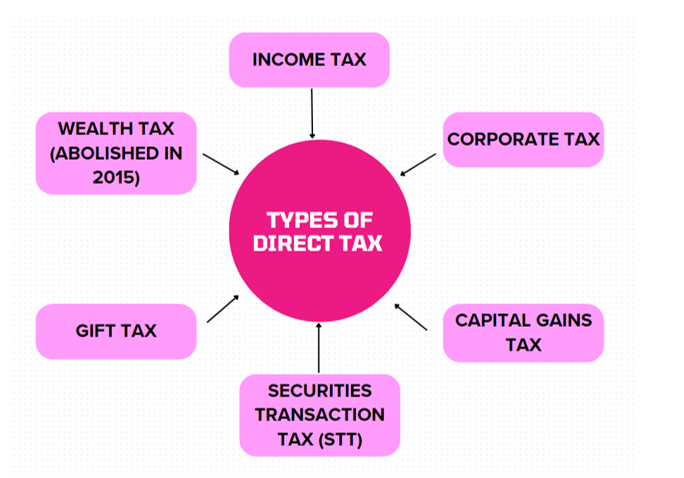
Types of Direct Tax

A Direct Tax is one that is levied upon a person or entity and paid to the government directly. It is impossible to transfer the tax burden to another person.

These are few types of direct tax:

Income Tax (IT)

According to the provisions of the Income Tax Act of 1961, income tax is a tax that is directly imposed on the earnings that individuals, Hindu Undivided Families (HUFs), businesses, limited liability partnerships (LLPs), enterprises, and other entities earn. Five categories are used to categorise the Income: Capital Gains, Profits and Earnings from Business or Profession, Income from House Property, Income from Salaries, and Income from Other Sources. After calculating the relevant deductions and exemptions (such as those provided by Sections 80C, 80D, etc.), tax is due on the total taxable income. Through the Finance Act, the government updates tax rates and slabs every year (Union Budget). The Government of India receives most of its revenue from income tax.

Corporate Tax

According to the Income Tax Act of 1961, Corporate tax is imposed on the net profit of businesses, both local and foreign. While international corporations are only taxed on their income made in India, domestic companies are taxed on their entire income. Under Sections 115BAA and 115BAB, businesses may choose to use concessional rates, subject to specific requirements. Companies may also be required to pay health and education cess and surcharges in addition to corporate tax. India’s revenue is largely derived from corporate taxes, particularly from big businesses in industries like manufacturing, finance, and information technology.

Capital Gains Tax

When Capital Assets, such as buildings, land, gold, shares, and other valuable property, are sold or transferred, the profits are subject to capital gains tax. It is divided into two categories according to the period of time the asset is held: Short-Term Capital Gains (STCG) and Long-Term Capital Gains (LTCG). Depending on the asset type and holding duration, the tax rate changes.

Securities Transaction Tax (STT)

The Securities Transaction Tax (STT) is a direct tax levied on securities-related transactions carried out on authorised stock exchanges, including the buying and selling of shares, derivatives, and equity-orientated mutual funds. In order to streamline the taxes of stock market transactions, it was created by the Finance Act of 2004. Different transaction types have different STT rates. Depending on the nature of the transaction, the buyer, seller, or both may be responsible for paying the tax, which is collected by stock exchanges.

Gift Tax

The 1958 Gift Tax Act served as the original legislation governing gift tax; however, it was repealed in 1998. Gift taxation is now regulated under Section 56(2)(x) of the Income Tax Act of 1961. The amount of gifts given to an individual or HUF in a fiscal year that exceed ₹50,000 in value (apart from certain relatives or exempt categories) is taxed as income from other sources. Some presents, including those given as a marriage present or as an inheritance, are still excluded.

Wealth Tax (Abolished)

A direct tax referred to as wealth tax was imposed on the net worth of specific people, HUFs, and businesses if it beyond the specified amount. It was regulated by the 1957 Wealth Tax Act. Real estate, gold, expensive cars, and jewellery were all subject to wealth tax. The Finance Act of 2015 eliminated wealth tax for the Assessment Year 2016–17 due to the high expenses of compliance and low revenue yield. However, in order to maintain transparency and stop tax evasion, high-value assets are still required to be reported on income tax returns.

Tax System in India: Meaning, Types, and Structure

Taxation is an essential resource for governance and revenue collection, and it is a sovereign right. The Constitution of India establishes the basis for taxation and divides authority between the central government and state governments.

In India, taxes are imposed in accordance with laws passed by the state and central governments. Direct and indirect taxes are the two main categories of taxes, and several acts and constitutional clauses regulate how they are implemented.

Constitutional Framework

The power to levy taxes in India is derived from:

Article 265: “No tax shall be levied or collected except by the authority of law.”

Article 246: Distribution of legislative powers under three lists:

  • Article 246(1): Union List
  • Article 246(3):  State List
  • Article 246(2): Concurrent List

Seventh Schedule: Subjects on which central, state, or both can levy taxes.

Classification of Taxes

Direct Tax: One cannot transfer direct taxes to another party; they are imposed directly on people or organisations. Examples are corporation tax and income tax. They are progressive, which means that those with higher incomes pay more, so advancing income equality.

Indirect Tax: Imposed on products and services and have the possibility to be transferred from producers to consumers. Customs duty, excise duty, and GST are a few examples. Regardless of income, all consumers pay the same rate, making these regressive in general.

CriteriaDirect TaxIndirect Tax  
NatureProgressiveRegressive
ExampleIncome Tax, Corporate TaxGST, Customs Duty
Burden             On the taxpayerPassed on to the consumer
Administered byCBDTCBIC
ComplianceComplex and documentation-heavyEasy to collect at point of sale

Cess and Surcharge

The terms “cess” and “surcharge” are frequently confused. Article 270 of the Constitution refers to a cess, which is a form of tax collected for a particular purpose, such as infrastructure or education. However, as stated in Article 271, a surcharge is an additional tax that is imposed on top of already-existing taxes, typically to generate money for certain purposes.

The Consolidated Fund of India, which the government uses for public spending, receives the sums from both cess and surcharge. In the M/s. SRD Nutrients Pvt. Ltd. vs. Commissioner of Central Excise, Guwahati [SC 2017] case, the Supreme Court made it clear that the higher education and education cess should be regarded as a surcharge.

Advantages and Disadvantages

AspectDirect TaxesIndirect Taxes  
NatureProgressive: determined by wealth or incomeRegressive – same rate for everyone
ProgressPromotes income equalityThe burden falls more on lower-income consumers
TransparencyClearly specified and documentedHidden in prices, consumers are unaware
Tax BurdenCannot be shifted to othersShifted to end consumers
AdministrationComplicated filing and compliance proceduresEasily gathered at the moment of sale
Stability of RevenuePredictable government revenueVaries according to patterns in consumption
Impact on InflationCan aid in reducing inflationTends to cause inflation and price increases
Risk of ComplianceIncreased chances of tax evasionIntegrated collection reduces evasion
Impact on EconomyCould discourage investmentPromotes saving; can be modified to meet policy objectives

This Article is here for educational purpose only. The Author here explains the very basic concept of Tax System in India.

INCOME TAX SLAB – OLD vs. NEW TAX REGIME

In the 2020 budget, the Indian government introduced a new tax regime to simplify the tax system. Taxpayers have the option to choose between the old and new tax regimes under the existing tax system. Both regimes use different methods for calculating income taxes, and their tax slabs and deductions differ; each tax system has unique advantages over the others.

The old regime permitted several exemptions and deductions. The new regime, on the other hand, aims for a simple process of filing by eliminating most of these deductions while offering reduced tax rates. A major advantage of the new system for FY 2025–2026 is that the tax burden is zero for incomes up to ₹12,00,000.

Old Tax Regime

The traditional Indian tax system is referred to as the “old tax regime”. The HRA, LTA, Sections 80C and 80D, and other exemptions and deductions are available to taxpayers under this regime to reduce their taxable income and, consequently, their tax liabilities. The old and new tax systems are offered to the taxpayers according to their choice.

New Tax Regime

In 2020, the new tax system went into effect. Tax rates are lowered for all income levels. Most exemptions and deductions, including HRA, LTA, 80C, 80D, and others, are eliminated, somehow. This led to a lack of interest in the new tax system. Currently, the default tax system is the new one as well. In Budgets 2023 and 2024, the government made a few changes to increase the regime’s stability.

FeaturesOld Tax RegimeNew Tax Regime
(FY 2025-2026)
Tax slabsHigherLower
Deductions/ExemptionsNumerous deductions and exemptions for various investments, expenses, and savings. These include deductions under Sections 80C, 80D, 80E, LTA, and house rent allowances.Restricted major deductions or exemptions.
Standard Deduction₹50,000₹75000
Income eligibility for rebate u/s 87AUp to ₹5,00,000 Rebate: 12,500Up to ₹12,00,000 Rebate: 60,000
ComplexityComplex due to various deductionsSimplified tax filing
Best forPeople who are claiming and paying home loan interest, HRA, etc.People who do not claim HRA, House property loss due to loan repayment, etc.
*Comparison between NEW TAX REGIME and OLD TAX REGIME

Which regime is best to choose?

You should consider several criteria while deciding between the new and old tax regimes:

  • Level of Income: Determine your yearly income and compare it to the tax slabs under the two regimes.
  • Financial Objectives: Think about your financial goals. This can involve making a long-term investing plan or setting aside money for retirement. Through deductions, the previous administration promoted smart saving.
  • Financial responsibilities: The old regime might have been preferable if planning for home loan, the income structure consists of HRA, where Sukanya samriddhi scheme is found more appropriate to investment for girl child, or any other financial planning.
  • Tax Deductions: Speak with a financial counsellor or use a tax calculator. Before choosing, you can use this to compare the actual taxes due under the two regimes.

Tax slab for financial year 2025 – 2026

New Tax Regime

The revised tax slabs under the new regime that are applicable from 1st April 2025 are as follows:

Tax SlabTax Rate  
Upto  Rs. 4,00,000Nil  
Rs. 4,00,001 – Rs. 8,00,0005%  
Rs. 8,00,001 – Rs. 12,00,000  10%  
Rs. 12,00,001 – Rs. 16,00,00015%  
Rs. 16,00,001 – Rs. 20,00,000  20%
Rs. 20,00,001 – Rs. 24,00,000  25%
More than 24,00,000  30%
*Revised Tax Slab Chart for New Tax Regime for FY 2025-2026 (AY 2026-2027)

Old Tax Regime

The tax slabs under the old regime is unchanged for AY 2025-26 and AY 2026-27 are as follows:

Tax SlabTax Rate 
Upto  Rs. 2,50,000Nil  
Rs. 2,50,001 – Rs. 5,00,0005%  
Rs. 5,00,001 – Rs. 10,00,000  20%  
Rs. 10,00,001 – Rs. 15,00,00030%  
More than 15,00,000  30%
*TAX SLAB for OLD TAX REGIME – NO Change in Slab

How to chose which Regime is better for you?

Taxpayers must know that NEW TAX REGIME has been set as default for all eligible taxpayers. One who wants to opt for the OLD TAX REGIME for tax computation, must select “OPT OUT” option within the due date of the return.

Also, the Taxpayer must mention Date of filing and Acknowledgement Number of the FORM 10-IEA for the same.

Disclaimer: The content here is only for reference and is subject to update time to time. To get to know the tax liability, consult your professional advisor or connect to our operation team via 91-9267970588 or taxacumen.consultancy@gmail.com
INCOME TAX REBATE UNDER SECTION 87A

Introduction

A tax deduction granted by Section 87A of the Income Tax Act, 1961 to Indian residents (it is not applicable to HUFs, businesses, or firms) whose total income for a financial year does not exceed ₹5,00,000. This ceiling limit is for the old tax regime. If your yearly income is ₹5 lakh or less, you are eligible to receive a deduction on the income tax that you owe to pay. The deduction is equal to either ₹12,500 or 100% of the tax owed, whichever is less.

After deducting other expenses, such as those under Section 80C or 80D, this deduction is applied. Your income may therefore be exempt from income tax altogether if it falls below the ₹5 lakh threshold. But if your income even slightly exceeds ₹5 lakh, you would not be qualified for this rebate.

The Indian Government is promoting the new tax regime to follow for tax payers to provide many additional benefits for the same. In this context, the limit of 87A has been increased for those who opt for the new tax regime. The said limits according to the relevant year is being discussed here in the article below.

Key Points for Old Tax Regime

  • Only applicable to individuals who are Indian residents and does not apply to Hindu Undivided  Family (HUF’s), Companies, or firms.
  • Yearly total income is 5 lakh or less,
  • Deduction is equal to either ₹12,500 or 100% of the tax owed, whichever is less,
  • Deductions (like 80C, 80D, HRA) is allowed

*There is no change in limit for those who opt for the old tax regime for this particular exemption to be claimed. This above said limit is applicable to FY 2024- 2025 and FY 2025-2026 as well.

Key Points for New Tax Regime

  • Only applicable to individuals who are Indian residents and does not apply to Hindu Undivided Family (HUF’s), Companies, or firms,
  • Yearly total income is 7 lakh or less. (for FY 2024-20205)
  • Deduction is equal to either ₹25,000 or 100% of the tax owed, whichever is less
  • Deductions (like 80C, 80D, HRA) is not allowed (except NPS, EPF, standard deduction etc).

*In budget 2025, FM raised the limit of income to ₹ 12 Lacs for the exemption under section 87A from the Financial year starting from  1st April 2025, i.e. for FY 2025-2026 and rebate of Rs. 60,000 or 100%, whichever is less is allowed under the new regime for the same. 

Standard Deduction

Introduction: Pensioners and salaried individuals are allowed to claim the standard deduction without requiring proof or documentation from the salary or pension part of income. Here as well, there are two limits that have been provided to tax payers on the basis of old and new tax regimes. By lowering the gross salary, this deduction lowers the taxable income.

Eligibility: Only pensioners and salaried individuals are eligible for the deduction of 75,000 under the new tax regime and 50,000 for old tax regime.

For example, a salaried person making ₹7.75 lakh a year would qualify for the full ₹25,000 refund under Section 87A since their taxable income would be ₹7 lakh after the standard deduction for the year 2024 – 2025 as a financial Year.

Marginal Relief under Section 87A

Marginal relief has been introduced for those taxpayers who earn a little bit more than the rebate maximum (such as ₹7,01,000 under the new regime) from having to pay more tax than the additional income. To prevent this scenario, it has been provided.

Also, there is no provision of marginal relief for taxpayers who opt for the old regime, if income exceeds ₹5,00,000 even with ₹1. This benefit is available for the new tax regime taxpayers.

In case, the taxpayer is earning ₹5,00,001 under the old tax regime after all the deductions other than 87A, the person needs to pay tax on ₹5,00,001 ignoring the benefit of 87A. The taxpayer does not fall for the limit here to claim section 87A.

Example of Marginal Relief

  • Income: ₹7,00,000 → Tax = ₹0 (after rebate)
  • Income: ₹7,01,000
  • Tax on ₹7,01,000 = ₹25,050
  • Extra income = ₹1,000
  • Extra tax = ₹25,050

The provision of marginal relief helps to avoid this unjust burden. The amount of tax that must be paid cannot exceed the amount which would be payable for the income of 7,00,000 and the minor excess income earned over the year. This means that instead of paying ₹25,050 in taxes, the individual will only pay ₹1,000.

Feature  Old Tax Regime  New Tax Regime (FY 2024-2025)  
Eligibility  Resident Individuals  Resident Individuals  
Rebate Income Limit  Total income ≤ ₹5,00,000  Total income ≤ ₹7,00,000  
Maximum Allowable Rebate  ₹12,500  ₹25,000  
Marginal Relief Available?  Not specifically statedYes, provided to avoid paying more tax on minor excess income  
Deductions (like 80C, 80D, HRA)  Allowed  Not allowed (except NPS, EPF, standard deduction etc.)  
Best for Whom?  Those whose income is below ₹5 lakh due to deductions  Those with incomes up to ₹7 lakh and no or few deductions  

How to File a Section 87A Tax Rebate Claim

Step 1: Figure out how much money you made overall during your financial year.

Step 2: Reduce the amount of your tax deductions for investments, tax savings, etc.

Step 3: After deducting the tax deductions, calculate your total taxable income.

Step 4: Fill out your ITR by declaring your gross income and tax deductions.

Step 5: If your total income stays below certain thresholds, you can claim a tax refund under section 87A.

Disclaimer: The content here is only for reference and is subject to update time to time. To get to know the tax liability, consult your professional advisor or connect to our operation team via 91-9267970588 or taxacumen.consultancy@gmail.com
GST REGISTRATION PROCESS in INDIA

Any person falling under the laws of GST must need to get registered under the GST and have the GSTN. Click the link here to know, whether you are falling within limit GST registration threshold limit, https://taxacumen.in/?p=978 and to understand the benefits of the same https://taxacumen.in/?p=986

Here, we will not discuss again whether you are required to have GST or not, but to know step-by-step registration process to apply for the same.

Step 1

Go to the Website https://www.gst.gov.in/ and to register, go to the “Register” tab on the Right side in Top location. If you are here for the first time go to “New Registration” and if you already have TRN, Click to TRN.

Step 2

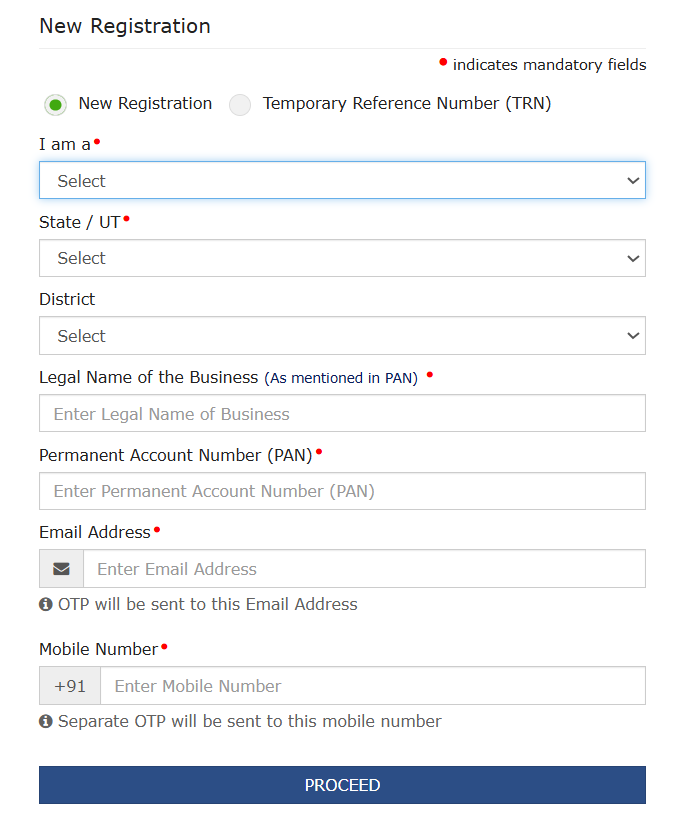
You will get to watch the screen as mentioned here, fill the details asked here to proceed when you dont have TRN already

Select whether you are  Taxpayer, Input Service Distributor(ISD), Tax Deductor, Tax Collector (Ecommerce Operators), Non Resident Taxable Person, GST Practitioner, or else.

Also, mention your legal name as per Permanent Account Number (PAN) only, Business Name can be differ.

Mention your email Address and Mobile number for OTP and all future correspondence with the GST Department. Make sure to provide active email and mobile number.

And after filling all the details and information here, Click on Proceed to reach the next page.

Step 3

You will receive a page to enter a valid OTP, here Email and Mobile OTP will be the same. You can check and mention any of them to proceed.

Step 4

Once the OTP you entered above verified and approved, you will get this Screen, where TRN (Temporary Reference Number) will be mentioned for you. 

Save the TRN and write it down to your notepad for future correspondence. You will also get the said TRN through the text in messages and in your email mentioned in the application.

Step 5

Now, you have TRN with you to proceed for GST Registration. You must know that TRN will be available for 15 days to complete the process with the same TRN. Otherwise, a new TRN will be required.

Now you will login the Portal with your Received TRN and OTP to be received through your email and mobile both. After entering the OTP, you will be reached at a page where your Draft application is being shown.

Step 6

Here, you must complete this draft application within 15 days from generating the TRN. Till the date you didn’t get a GST Number from the GST Department, you can login with TRN for your registration.

Step 7

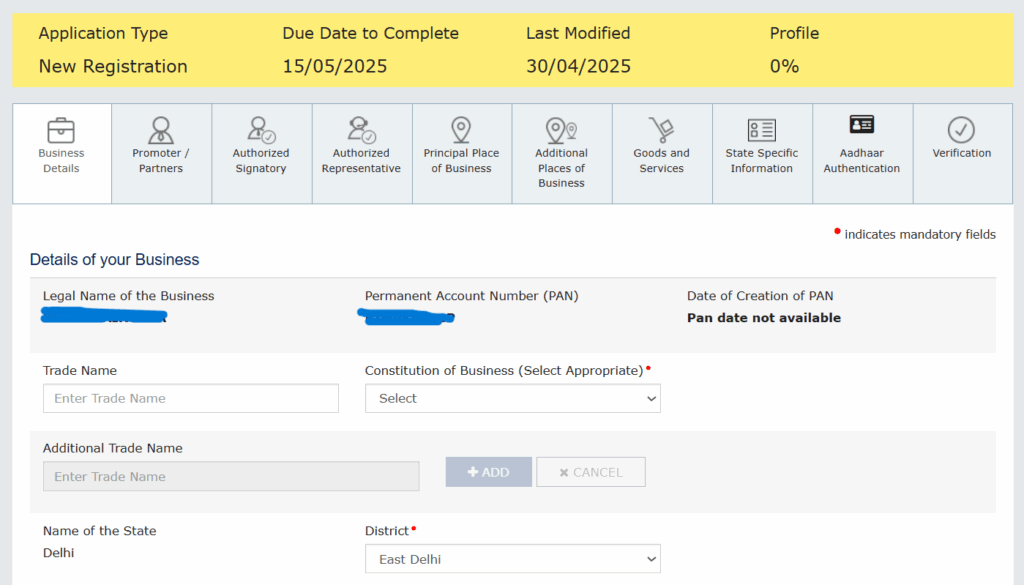
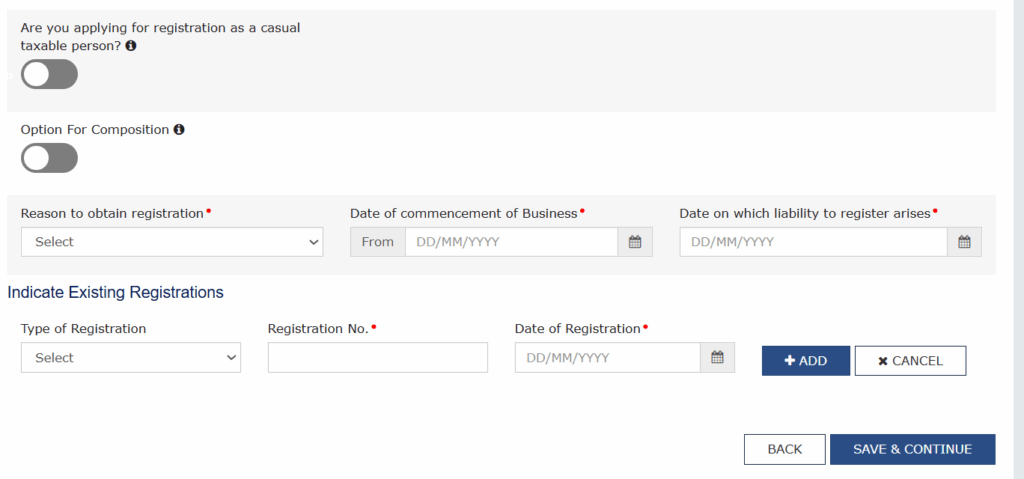
Here, you must provide Trade Name of business, Address details and proof of premise where the business is being operated, Personal details of Proprietor/Partners/Directors, Documentary proof of any additional premise for business to be attached, and all the details asked in the draft form must be provided. 

Here in the image, this is only first page of the draft form. The Applicant must complete the entire draft application, then Profile completion % mentioned in the right side of the image will be shown as 100%

Step 8

Aadhaar Authentication process

After the completion of the draft form, verification process is being done according to rules and provisions. There is an option to do Aadhaar Authentication with biometric verification of the primary authorized person. Where the mobile number of the primary responsible person used for registration is the same number with which Aadhaar has been linked, it is possible to authenticate the Aadhaar online with OTP. It cuts the time process of approval from the department within 7 days. 

Also, where a person opts to not to authenticate Aadhaar as described here before, he/she  can upload an Aadhaar copy to complete the KYC process. In such case, the GST Officer must verify the principal place of business physically and the time limit to approve the GST Registration Application is within 30 days.

It is advisable and beneficial to do Aadhaar authentication with biometric verification for GST Registration.

Step 9 

Approval of GST Application

Once the department is satisfied with all the details mentioned here and documents attached, the application will be approved. The applicant will receive an automatically sent mail having the login credentials in it.

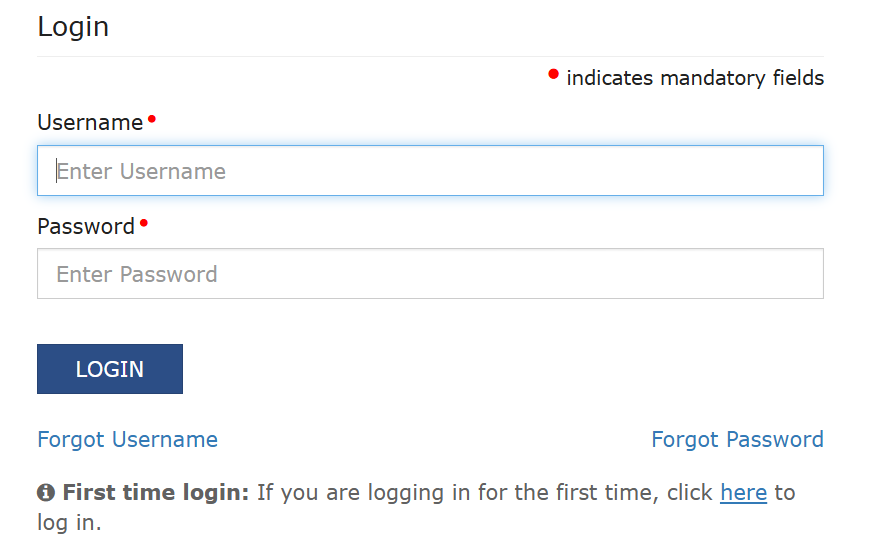
Login path for First time users must be used, Here, Create the User Id ( not changeable) and change the system password given by the department through the mail.

Step 10 

Bank Account Update

Generally people thinks GSTN is received and work is done. But, this is untrue. The registered taxpayer must add their bank details with a cancel cheque or bank passbook first page mandatorily within 45 days from the date of registration granted.

In case of non compliance, the department can cancel the GST Registration after the deadline passed.

About Author – Deepa Kaintura

I am a lawyer by profession. I am a legal consultant in TaxAcumen providing services to corporates about GST, Income Tax, ROC Compliances, etc. My love for finance and law encouraged me to write and share the knowledge with the readers here. For any query, reach us at 

WhatsApp : +91-9267970588 Email I’d:taxacumen.consultancy@gmail.com