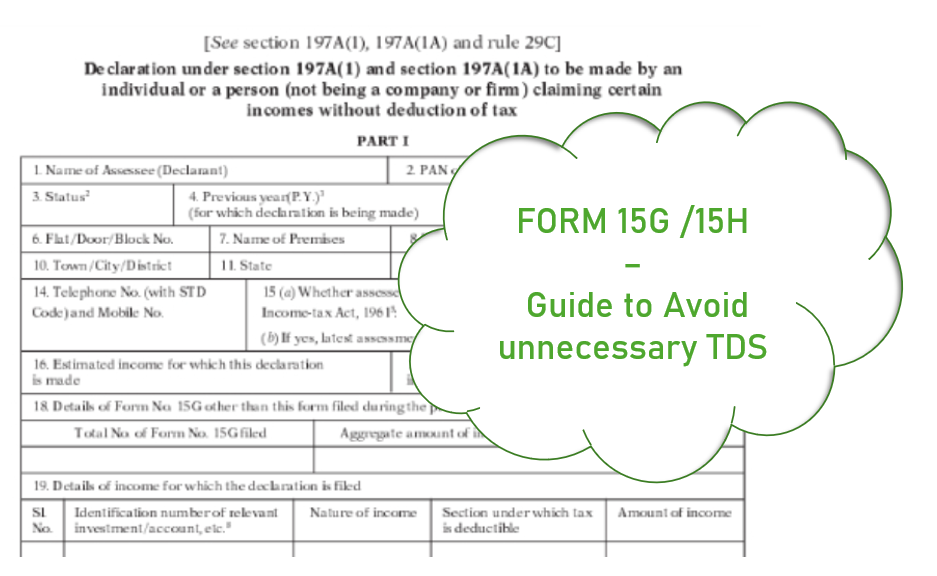
Form 15G and 15H: Simple Guide to Avoid Unnecessary TDS
Many taxpayers face situations where TDS (Tax Deducted at Source) is deducted from their income even when they do not have to pay any tax. Later, they have to claim a refund while filing the return. To avoid this hassle, the Income Tax Act allows eligible people to submit Form 15G or Form 15H.
These forms are self-declarations asking the payer (like banks, EPF offices, insurance companies, etc.) not to deduct TDS if your total income is below the taxable limit or your tax liability is nil.
What are Form 15G and Form 15H?
- Form 15G is for residents below 60 years, Hindu Undivided Families (HUF), and certain trusts.
- Form 15H is for resident senior citizens aged 60 years and above.
Both forms can only be filed by Indian residents. NRIs cannot use them. These forms can be submitted to banks and other tax deductor to ensure that TDS is not deducted where it is not applicable.
Who Can Use These Forms?
You can submit Form 15G if:
- You are below 60 years.
- Your total income is below the basic exemption limit (₹2.5 lakh in old regime, ₹4 lakh in new regime for FY 2025–26).
- There is no tax payable on your total income.
You can submit Form 15H if:
- You are a resident senior citizen (60 years or older).
- Your tax liability is nil, even if interest income exceeds the exemption limit.
When and Where to Submit?
These forms must be submitted at the start of every financial year (preferably in April). This way, banks or other institutions will not deduct TDS throughout the year.
You can submit them:
- To banks (for FD, RD, or savings interest)
- To EPF authorities (for withdrawals before 5 years)
- To companies (for bonds or dividends)
- To post offices (for deposits)
- To tenants (for rent subject to TDS)
- To insurance companies (for commission or maturity proceeds)
Most banks also accept online submission via their website.
Where Are These Forms Useful?
These forms are commonly used to avoid TDS on:
- Bank interest on FD/RD (Sec 194A)
- EPF withdrawals (Sec 192A)
- Rent (Sec 194-I)
- Dividends (Sec 194, 194K)
- Insurance commission (Sec 194D)
- Life insurance maturity (Sec 194DA)
- Corporate bond interest (Sec 193)
- National Savings Scheme withdrawals (Sec 194EE)
Each of these has a specific threshold, beyond which TDS applies if forms are not submitted.
What If You Forget to Submit?
If you miss the deadline, TDS may still be deducted. However, you can:
- File an Income Tax Return to claim the refund.
- Submit the form later to stop further deductions for the rest of the year.
Filling the Forms – Step by Step
When filling Form 15G/15H, you need to:
- Enter your name, PAN, and residential status.
- Mention the financial year for which the form is being filed.
- Declare your estimated income (interest, rent, etc.) where TDS applies.
- State your total expected income for that year.
- Provide investment details (FD numbers, bond details, etc.).
- Sign the declaration confirming that your tax liability is nil.
Only fill this form if you meet the eligibility conditions. Filing a false declaration can lead to penalties and imprisonment under the Income Tax Act.
Penalty for False Declaration
If someone files these forms even when their income is taxable, it is considered a false statement. This may lead to:
- Imprisonment (3 months to 7 years), and
- Heavy fines, especially if the tax evaded is above ₹25,000.
So, be truthful while filing.
Conclusion
Forms 15G and 15H are simple forms to avoid unnecessary TDS deductions. They save you from the trouble of claiming refunds later. Submit them every year at the start of April, ensure all details are correct, and keep copies for records.
For seamless process, consult a tax expert or use online resources provided by banks and the Income Tax Department.
Leave a Reply