
IncomeTax Refund : Step-by-Step Process

Many people pay more tax than they actually owe, either because of advance tax, TDS deductions, or calculation errors. When this happens, the extra amount you paid can be claimed back as an income tax refund. The process is completely online and easy to follow if you know the right steps.

What is an income tax refund?

An income tax refund is the money returned by the Income Tax Department when the tax you paid is more than your actual liability. This usually happens if:

  • Too much TDS was deducted by your employer or bank.
  • You paid advance tax or self-assessment tax that turned out to be higher than the actual amount due.
  • You claimed deductions or exemptions later that reduce your taxable income.
  • There is double taxation on your income in India and another country.

The rules for tax refunds are given under Sections 237 to 245 of the Income Tax Act, 1961.

Who Can Claim a Tax Refund?

You are eligible for a refund in the following cases:

  • Advance tax paid exceeds your actual liability.
  • Self-assessment tax is more than the payable amount.
  • TDS deducted is more than your final tax calculation.
  • An error occurred in the tax assessment, and you corrected it.
  • You declared deductions or investments later (e.g., under Section 80C).
  • Your income was taxed both in India and abroad (covered under DTAA).

Step-by-Step Process to Claim Your Tax Refund

The Income Tax Department has made the refund process simple and digital through the Income Tax e-filing portal (www.incometax.gov.in). Follow these steps:

Step 1: File Your Income Tax Return (ITR)

You must file your ITR before the deadline (usually July 31 unless extended). While filing, enter all income details, deductions, and exemptions. For example, investments in PPF, ELSS, or life insurance can be claimed under Section 80C up to ₹1.5 lakh.

Step 2: System Calculates Refund

After you submit the details, the system automatically compares your tax liability with the taxes you have paid. If you paid extra, the refund amount will be shown on the ITR form.

Step 3: Verify Your ITR

Once the return is filed, you need to verify it online using Aadhaar OTP, net banking, or by sending a signed physical copy (ITR-V) to CPC Bengaluru. Without verification, the return is not processed, and no refund will be issued.

Step 4: Processing and Intimation

The Centralised Processing Centre (CPC) checks your return and sends an intimation under Section 143(1) to your registered email. It will mention:

  • No refund is due.
  • The refund was accepted and will be credited soon.
  • Claim rejected or additional tax payable.

Step 5: Refund Credited to Bank Account

If your claim is approved, the refund will be directly credited to your bank account linked with your PAN and pre-validated on the portal. Always check that your account details are correct to avoid delays.

How to Track Your Refund Status?

You can easily check the status of your refund:

  • On the e-filing portal: Login → “View Returns/Forms” → “Refund/Demand Status.”
  • On the NSDL Refund Portal: Enter your PAN and assessment year.

Interest on Income Tax Refund

Under Section 244A, if the refund is delayed, you will get simple interest at 6% per year (0.5% per month). The interest is calculated:

  • From 1st April of the assessment year till the refund date if you filed on time.
  • From the filing date if you filed late.

This interest is taxable under “Income from Other Sources.”

Conclusion

Getting an income tax refund in India is simple if you file your return on time and provide correct details. The entire process is online, quick, and transparent. If you are eligible for a refund, make sure to claim it promptly and track the status regularly. Filing accurate returns not only ensures refunds but also keeps you compliant with tax laws.
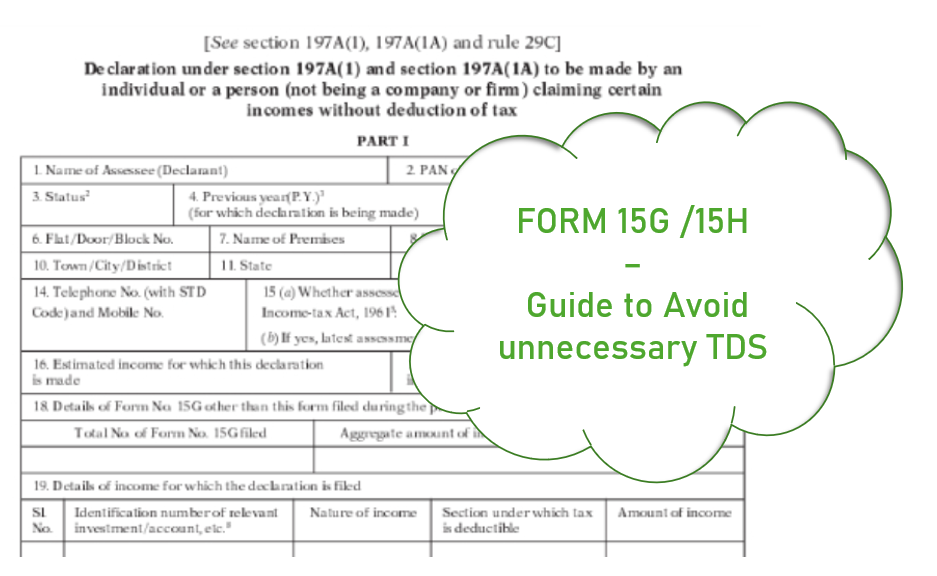

Form 15G and 15H: Simple Guide to Avoid Unnecessary TDS

Many taxpayers face situations where TDS (Tax Deducted at Source) is deducted from their income even when they do not have to pay any tax. Later, they have to claim a refund while filing the return. To avoid this hassle, the Income Tax Act allows eligible people to submit Form 15G or Form 15H.

These forms are self-declarations asking the payer (like banks, EPF offices, insurance companies, etc.) not to deduct TDS if your total income is below the taxable limit or your tax liability is nil.

What are Form 15G and Form 15H?

  • Form 15G is for residents below 60 years, Hindu Undivided Families (HUF), and certain trusts.
  • Form 15H is for resident senior citizens aged 60 years and above.

Both forms can only be filed by Indian residents. NRIs cannot use them. These forms can be submitted to banks and other tax deductor to ensure that TDS is not deducted where it is not applicable.

Who Can Use These Forms?

You can submit Form 15G if:

  • You are below 60 years.
  • Your total income is below the basic exemption limit (₹2.5 lakh in old regime, ₹4 lakh in new regime for FY 2025–26).
  • There is no tax payable on your total income.

You can submit Form 15H if:

  • You are a resident senior citizen (60 years or older).
  • Your tax liability is nil, even if interest income exceeds the exemption limit.

When and Where to Submit?

These forms must be submitted at the start of every financial year (preferably in April). This way, banks or other institutions will not deduct TDS throughout the year.

You can submit them:

  • To banks (for FD, RD, or savings interest)
  • To EPF authorities (for withdrawals before 5 years)
  • To companies (for bonds or dividends)
  • To post offices (for deposits)
  • To tenants (for rent subject to TDS)
  • To insurance companies (for commission or maturity proceeds)

Most banks also accept online submission via their website.

Where Are These Forms Useful?

These forms are commonly used to avoid TDS on:

  • Bank interest on FD/RD (Sec 194A)
  • EPF withdrawals (Sec 192A)
  • Rent (Sec 194-I)
  • Dividends (Sec 194, 194K)
  • Insurance commission (Sec 194D)
  • Life insurance maturity (Sec 194DA)
  • Corporate bond interest (Sec 193)
  • National Savings Scheme withdrawals (Sec 194EE)

Each of these has a specific threshold, beyond which TDS applies if forms are not submitted.

What If You Forget to Submit?

If you miss the deadline, TDS may still be deducted. However, you can:

  • File an Income Tax Return to claim the refund.
  • Submit the form later to stop further deductions for the rest of the year.

Filling the Forms – Step by Step

When filling Form 15G/15H, you need to:

  • Enter your name, PAN, and residential status.
  • Mention the financial year for which the form is being filed.
  • Declare your estimated income (interest, rent, etc.) where TDS applies.
  • State your total expected income for that year.
  • Provide investment details (FD numbers, bond details, etc.).
  • Sign the declaration confirming that your tax liability is nil.

Only fill this form if you meet the eligibility conditions. Filing a false declaration can lead to penalties and imprisonment under the Income Tax Act.

Penalty for False Declaration

If someone files these forms even when their income is taxable, it is considered a false statement. This may lead to:

  • Imprisonment (3 months to 7 years), and
  • Heavy fines, especially if the tax evaded is above ₹25,000.

So, be truthful while filing.

Conclusion

Forms 15G and 15H are simple forms to avoid unnecessary TDS deductions. They save you from the trouble of claiming refunds later. Submit them every year at the start of April, ensure all details are correct, and keep copies for records.

For seamless process, consult a tax expert or use online resources provided by banks and the Income Tax Department.

Step wise Guide for Freelancer to file ITR

Although freelancing gives you great flexibility and independence over the work you do, it also includes the responsibility of managing your taxes on your own. In comparison with salaried workers who receive Form 16 and employer support, freelancers are responsible for monitoring their own earnings, expenses, and compliance deadlines.

In addition to avoiding penalties, filing your Income Tax Return (ITR) accurately is essential for maintaining your credit score, claiming deductions, and ensuring future loans and credit can be obtained easily. Although tax filing as a freelancer may appear difficult at first, it is easy with the correct strategy.

Who Needs to File ITR as a Freelancer?

Freelancers are considered those who make money under the Income Tax Act’s “Profits and Gains from Business or Profession” category. You fit into this category if you are self-employed and make money from your skills, services, or consulting.

An ITR must be filed if:

  • The basic exemption (₹2.5 lakh under the previous regime and ₹3 lakh under the new regime for FY 2024–25) is exceeded by your yearly income.
  • You could be subject to a tax audit if your gross receipts are over ₹50 lakh (or ₹75 lakh if your cash receipts exceed 5%).
  • You want the extra TDS that your clients deducted to be refunded.
  • You are making an advance tax payment, which is required if your yearly tax liability is more than ₹10,000.

Applicable ITR Forms

  • ITR-3: For freelancers filing income under standard rules.
  • ITR-4 (Sugam): For those applying for the Presumptive Taxation Scheme under Section 44ADA, where 50% of gross earnings are treated as taxable income.

Step-by-Step Procedure for Filing ITR as a Freelancer

Even if the procedure could seem complicated, it is simple to follow when it is divided into different steps:

Step 1: Collect All Income Records

Gather bank statements, invoices, payment receipts, and any TDS certificates (Form 16A) that you may have received from clients. The basis of error-free filing is accurate income reporting.

Step 2: Calculate Net Taxable Income

The rent for a home office, internet, utilities, travel expenditures, professional devices, and software subscriptions are all examples of expenses that freelancers can deduct from their total income. This provides your net income, which is used for calculating taxes.

Step 3: Claim Allowable Deductions

You can reduce taxable income more by claiming deductions under multiple sections:

  • 80C: Investments in PPF, ELSS, life insurance, etc.
  • 80D: Health insurance premiums.
  • 80GG: Rent paid if you don’t receive HRA.
  • 80G: Donations to eligible institutions.

Also, business-related expenses are fully deductible if they are used only for your freelancing work.

Step 4: Log in to the e-Filing Portal

Go to www.incometax.gov.in and log in using your PAN (which is used as your user ID). Select ‘File Income Tax Return’ and choose the applicable assessment year (AY 2025–26 for FY 2024–25).

Step 5: Select the Correct ITR Form

  • Use ITR-3 if filing under standard provisions.
  • Use ITR-4 if applying for presumptive taxation under Section 44ADA.

Selecting the correct form assures hassle-free processing.

Step 6: Fill in Income and TDS Details

Enter your entire income from freelancing, deductions, and any TDS that clients already deducted. Some information is automatically filled in Form 26AS, AIS, and TIS by the system, but you still need to double-check it.

Step 7: Calculate Tax and Pay Any Remaining Balance.

Your total tax liability will be calculated by the portal after all data has been entered. If taxes are due, use Challan ITNS 280 to make the payment online. Interest under Sections 234B and 234C can be avoided with timely payment.

Step 8: Submit and Verify ITR

Finally, within 30 days, mail a signed ITR-V form to the CPC Bengaluru, or electronically submit your return and get it verified using Aadhaar OTP or net banking. Your return will be considered invalid if it is not verified.

ALso, click here to know about Income tax compliances for freelancers https://taxacumen.in/?p=1179

Conclusion

As a freelancer, filing an ITR is not only a legal requirement; it is also an important part of managing your finances. You may claim refunds, avoid penalties, and maintain a clean financial record that enhances your credibility by submitting on time and accurately. You can manage tax compliance with credibility if you maintain complete records, take benefit of deductions, and follow the straightforward procedures mentioned above.

It is advisable to consult your tax advisor for better understanding to avoid heavy penalties for wrong filing, wrong deduction, mismatch values.

You can connect us

WhatsApp : +91-9267970588 Email I’d:taxacumen.consultancy@gmail.com

Follow us here: https://whatsapp.com/channel/0029VaXqUTnL2AU3Z1yxXD3S