ITR Validation Errors: How to Resolve?

For all Indian taxpayers, filing an Income Tax Return (ITR) is a crucial responsibility. It enables individuals as well as businesses to file their income reports, take benefits like deductions, and comply with tax regulations. However, taxpayers often come across validation errors throughout the filing process—problems identified by the Income Tax Department’s system that impact the return’s successful submission.

What are validation errors in ITR?

A validation error happens when the data entered in the ITR form doesn’t match the required format, calculations, or compliance rules set by the Income Tax Department (ITD). These errors typically appear during the validation stage when using the online portal or offline applications (Excel/JSON).

For example, if the PAN number doesn’t match with the record, or the total income entered does not add up properly, the system will detect an error. The message “Validation completed: 1 error found” means there is at least one mistake that needs correction before you can proceed.

Why Do Validation Errors Occur?

Common reasons for validation errors include:

  • Incorrect personal details—wrong PAN, Aadhaar, date of birth, or name mismatch.
  • Unfilled mandatory fields—not filling required information like bank details or address.
  • Special characters—using symbols like &, %, *, #, <, and > in fields where they are not allowed.
  • Data mismatch—inconsistency between ITR and Form 16, Form 26AS, or AIS.
  • Wrong ITR form—Selecting an incorrect form based on income type.
  • Calculation errors—manual errors in computing income, deductions, or tax liability.
  • Outdated DSC or software settings—using expired Digital Signature Certificates or incorrect browser settings.

These errors are classified into categories:

  • Category A: Blocks return upload completely.
  • Category B: Allows upload but indicates possible errors.
  • Category D: Uploads return but alerts about possible restrictions on deductions or claims.

How to Resolve Validation Errors in ITR

Fixing these errors is a step-by-step process. Here’s what you should do:

  • Identify the Error

Pay attention to the error message. Usually, it indicates which data or field is inaccurate. This is where you start fixing the issue.

  • Use the Correct ITR Form

Choosing the wrong form is a common mistake. Select the form that matches your income:

ITR-1: For salaried individuals with income up to ₹50 lakh (no capital gains).

ITR-2: For individuals/HUF with foreign income or capital gains.

ITR-3: For those with business/professional income.

ITR-4: For presumptive income under Sections 44AD/ADA.

  • Verify Personal Details

Ensure your PAN, Aadhaar, and name exactly match government records. Even a minor difference (extra space or spelling variation) can cause an error.

Validate PAN through the NSDL portal.

Ensure Aadhaar is linked correctly with PAN.

  • Fix Income and Deduction Errors

Cross-check income figures with Form 16, Form 26AS, and AIS.

Verify that the overall income matches the schedule breakup.

Deductions should be entered under the correct sections (80C, 80D, etc.).

  • Match TDS and Tax Credits

Ensure the TDS you claim matches Form 26AS. If there is a mismatch, ask the deductor to correct their TDS filing. Mistakes here often result in validation errors.

  • Avoid Special Characters

Do not use symbols like &, %, *, ~, or <> in text fields. Stick to letters, numbers, and proper punctuation.

  • Validate and Revalidate

If you are using the offline Excel/JSON utility:

Use the Validate button for each sheet.

  • Fix highlighted issues.

Click Calculate to recompute totals.

Refresh and upload the corrected JSON file.

  • Check Bank Details and IFSC

Enter correct bank account numbers and IFSC codes. Verify them with your passbook or bank portal.

  • Fix Digital Signature Issues (if applicable)

Ensure your DSC is valid and registered.

Use the latest drivers and Java version.

Verify that the DSC PAN matches the assessee’s PAN.

  • Adjust Browser or Internet Settings

For errors like “NULL error” or upload failures:

Clear the browser cache.

Try using another browser like Chrome or Edge.

Ensure a stable internet connection.

  • Use Updated and Verified Data

Don’t depend completely on pre-filled data. Always verify figures manually and update outdated information.

  • Seek Help When Needed

If errors persist:

Call the ITD Helpdesk at 1800-103-0025 or 1961.

Raise a grievance on the e-filing portal.

Consult a chartered accountant for complicated cases.

Conclusion

Although validation errors in ITR filing can be annoying, they act as a checkpoint to guarantee accuracy. You can quickly fix error warnings by carefully reading them, using the right information, and again verifying the form. In addition to speeding up processing and refunds, accurately filing returns protects you from penalties and notices.

Tax Audit Under Section 44AB : Overview

As a professional, tax consultant, or business owner, you probably have heard of a tax audit under Section 44AB. Even though it could seem complicated at first, it’s an essential component of Indian income tax compliance.

This article explains what a Section 44AB tax audit actually involves, who needs one, the restrictions, due dates, and useful tips to help you avoid penalties and reduce stress.

What is a tax audit?

In simple terms, a tax audit is when a chartered accountant (CA) looks over your books of accounts to make sure that income, expenses, and tax-related data are accurately recorded and reported. It guarantees precision and adherence to the 1961 Income Tax Act.

Why Section 44AB?

Section 44AB requires tax audits for specific taxpayer groups according to their turnover, gross receipts, or profits. The goal is to encourage transparency and prevent tax avoidance.

Who would require a tax audit in AY 2025–26?

As per current law, the following persons are required to get their accounts audited under Section 44AB:

  1. Business (Not opting for presumptive taxation)

If your total sales, turnover, or gross receipts exceed ₹1 crore in a financial year, you are liable for a tax audit. However, this threshold is increased to ₹10 crore if your cash receipts and cash payments do not exceed 5% of total receipts and payments, respectively.

  • Professionals
  • If your gross receipts exceed ₹50 lakh, a tax audit is mandatory.
  • Presumptive Taxation Scheme (Sections 44AD, 44ADA, 44AE)

If you opt out of the presumptive scheme and your income is below the deemed profit rate (8%/6%/50%) and your income exceeds the basic exemption limit, a tax audit becomes applicable.

Important Updates and Changes for AY 2025–2026

Here are some current as well as future developments to be aware of:

  • Increased Technology Use: Accurate reporting is now more crucial than ever because of e-filing and AI-driven scrutinizing tools.
  • Mismatch Reporting: More quickly, instances of discrepancies between GSTR filings and ITRs are being identified. Make sure the data is consistent.
  • Updates to the CBDT Guidelines (if any): Always keep an eye out for any new circulars or clarifications that the CBDT may have released on audit thresholds or formats.
  • Due Date for the Tax Audit Report

The deadline for submitting the tax audit report (Form 3CA/3CB with Form 3CD) for AY 2025–26 is anticipated to be September 30, 2025, unless the government extends this period.

To avoid mistakes or penalties at the last minute, it is always advisable to complete your audit well in advance of the deadline.

The consequences for non-compliance

If an individual is accountable for an audit but does not complete it:

  • A fine under Section 271B could be applied.
  • Either ₹1,50,000 or 0.5% of total sales, turnover, or gross receipts, whichever is lower.
  • Avoiding these monetary and legal setbacks is made easier with timely compliance.
  • What is examined by the auditor?

The CA conducting the audit will verify:

  • Accuracy of books of accounts
  • Reconciliation with GST returns
  • TDS compliance
  • Cash transactions
  • Reporting of loans/advances above prescribed limits
  • Disclosures under Clauses of Form 3CD
  • Documents Required for Tax Audit
  • Trial balance and ledgers
  • GST returns
  • TDS statements
  • Income tax computation
  • Bank statements
  • Details of fixed assets and depreciation
  • Previous audit reports, if any
  • Tips for a Smooth Audit
  • Don’t wait until September; get started early. Compile the paperwork by July or August.
  • Work together with your CA: clear communication speeds up problem-solving.
  • Verify that the GST and TDS filings correspond with your books.
  • Go digital: To keep accurate records, use accounting software.

Conclusion

Section 44AB tax audits involve more than merely compliance. Additionally, it helps you evaluate your financial situation, identify problems early, and make better plans for the upcoming year. Timely and accurate audits are becoming necessary rather than voluntary as tax regulations become more rigorous and digital monitoring increases.

Knowing your responsibilities under Section 44AB can help you avoid legal issues in AY 2025–2026 and save time and money, regardless of your level of experience as a business owner.

Tax Benefits for First-Time Home Buyers in India

Many people dream of owning a home, and the Indian government provides first-time homebuyers with a number of tax benefits to help make this ambition possible. In addition to reducing your loan pressure, these benefits promote affordable housing, particularly for middle-class and economically disadvantaged people.

Who qualifies as a first-time homebuyer?

A first-time homebuyer is not simply someone who is buying a house for the first time in their life. As per Indian tax law, a first-time homebuyer is someone who has not owned a residential property for a period of three years.

There are several tax deductions available to these buyers if they satisfy certain conditions with regard to the value of the property, the value of the loan, and the related timing of the purchase.

Major Tax Benefits for First-Time Homebuyers

The tax advantages listed below can significantly lower the cost of buying your first house:

1. Principal Repayment Deduction – Section 80C

  • Up to ₹1.5 lakh can be deducted from the principal amount of your house loan for each financial year.
  • Only if the property is not sold within five years after the date of possession is this deduction possible.
  • The deduction is included in Section 80C’s overall ₹1.5 lakh cap, which also covers investments such as PPF and ELSS.

2. Deduction on Interest Paid – Section 24(b)

  • You can claim up to ₹2 lakh per annum as a deduction on interest paid for your home loan.
  • This applies to self-occupied residential properties only.
  • To avail of this benefit, the construction or acquisition of the property must be completed within 5 years from the date of borrowing.

3. Additional Deduction – Section 80EE

  • First-time homebuyers who took out a loan during the 2016–17 fiscal year are eligible to deduct an extra ₹50,000 from the interest they paid.
  • The ₹2 lakh deduction under Section 24(b) is in addition to this.
  • Both the loan amount and the property value should not be greater than ₹35 lakh and ₹50 lakh, respectively.

4. Additional Housing Deduction – Section 80EEA

  • One more deduction of ₹1.5 lakh can be claimed by buyers purchasing affordable homes between FY 2020 and 2022 for interest paid.

Terms:

  • The maximum value of a property is ₹45 lakh.
  • For metro areas, the carpet area should be no more than 60 square metres (645 square feet), and for other places, it should be no more than 99 square feet.
  • Keep in mind that you can only make a claim under Section 80EE or 80EEA, not both.

5. Tax Benefits under Section 80GG without HRA

  • You can claim a deduction under Section 80GG if you are paying rent while buying a home and do not receive the House Rent Allowance (HRA).
  • Subject to certain restrictions, rent that exceeds 10% of total income may be taxed.

6. Pradhan Mantri Awas Yojana (PMAY) Benefits of GST

  • Under PMAY, the GST on affordable housing has been lowered to 1% for eligible purchasers.

Interest subsidies are available to buyers who earn up to ₹18 lakh annually:

  • For Economically Weaker Sections (EWS) earning up to ₹3 lakh, the rate is 6.5%.
  • 4% for those in the Lower Income Group (LIG) who make up to ₹6 lakh.
  • 3% for individuals in the Middle-Income Group (MIG) who make up to ₹12 lakh.

Ways to Maximise Your Advantages

  • Plan your purchase to take advantage of interest subsidies and lower GST rates by aligning it with government programmes like PMAY.
  • Monitor loan eligibility requirements:
  • Aim for a credit score of 750 or higher.
  • Make sure your income and ability to repay are steady.
  • Utilise online home loan EMI calculators to evaluate and compare loan offers from various banks.
  • Verify all extra expenses, including processing fees, stamp duty, and registration fees, before completing the purchase.

Conclusion

The tax advantages provided by the Indian government can make the financial process of purchasing your first property easier. GST reductions, affordable housing subsidies, and principal and interest repayment deductions are all meant to encourage homeownership, particularly among middle-class and first-time purchasers.

KEY FINANCIAL AND COMPLIANCE CHANGES EFFECTIVE FROM JULY 1, 2025

From July 1, 2025, several key financial and regulatory changes will come into force in India. These changes are intended to improve tax compliance, enhance digital governance, and reduce discrepancies in financial reporting. The changes will affect businesses, salaried individuals, and taxpayers at large. Whether you own a business or are filing your taxes, being aware of these updates will help you stay on track and avoid last-minute problems.

1. GSTR-3B Filing Now Locked Post Filing

A significant change under the Goods and Services Tax (GST) regime is the more careful assessment of GSTR-3B returns. GSTR-3B is a summary return that includes details of sales, tax liability, and input tax credit (ITC) for the tax period.

Starting July 1, 2025:

  • Once GSTR-3B is filed, it cannot be edited or revised.
  • Any required corrections must be made through the newly introduced GSTR-1A form, but only before filing GSTR-3B.
  • Businesses can make just one correction per tax period through GSTR-1A.
  • Reverse charge-related transactions can still be entered manually.

This approach ensures better alignment between sales data reported in GSTR-1 and the final tax liability declared in GSTR-3B. Businesses will now need to carry out thorough checks before filing, as errors will be irreversible after submission.

2. New Three-Year Deadline for Filing Pending GST Returns

The government has also introduced a three-year time limit for filing pending GST returns, effective from July 1, 2025. After this period expires, businesses will no longer be able to file returns for older tax periods.

This rule applies to various GST return types, including:

  • GSTR-1
  • GSTR-3B
  • GSTR-4
  • GSTR-5
  • GSTR-5A
  • GSTR-6
  • GSTR-7
  • GSTR-8
  • GSTR-9

For instance, starting July 1, 2025, returns for tax months prior to June 2022 will be permanently time-barred. In order to prevent penalties and the loss of ITC benefits, Businesses that have unfiled returns for prior periods should make sure they file them before this deadline.

3. Introduction of a Second E-Way Bill Portal

On July 1, 2025, the government launched a “Second E-Way Bill” site, accessible at https://ewaybill2.gst.gov.in, to increase system stability and operational efficiency.

The recently launched portal provides:

  • Reduced dependence on one particular platform
  • Updates to data in real time across portals
  • Businesses get uninterrupted access during rush-hour periods.
  • Businesses engaged in the transportation of products will benefit from this advancement by avoiding disruptions and ensuring compliance without system delays.

4. Extended Period for Filing ITR

Additionally, there is some relief for taxpayers. For small taxpayers and salaried persons, the deadline for submitting Income Tax Returns (ITR) for Assessment Year 2025–2026 has been moved from July 31 to September 15, 2025.

Although the extension gives more time, it is advised to file early in order to:

  • Avoid last-minute portal traffic.
  • Get your tax refunds earlier.
  • Fix any errors or discrepancies as soon as possible.
  • Additionally, timely filing guarantees hassle-free tax processing and helps avoid fines.

5. Aadhaar Now Mandatory for New PAN Registrations

Getting a new Permanent Account Number (PAN) is another significant step. People who want to apply for a PAN will need to submit their Aadhaar as a requirement of the application procedure starting on July 1, 2025.

Furthermore:

  • By December 31, 2025, current PAN holders who applied with an Aadhaar enrolment number must finish the Aadhaar-PAN linking process.
  • PAN cards would stop working if they are not connected to Aadhaar by the deadline.
  • The action attempts to stop identity theft in financial transactions and is in line with the government’s digital ambitions.

6. Additional Focus on GST Automation

The GST system is being further automated in accordance with the initiative for digital governance in order to minimise errors and false claims.

Important points include:

  • GSTR-3B will now automatically be filled up using data from GSTR-1, eliminating the need for post-filing manual revisions.
  • GSTR-3B and tax liabilities will be immediately impacted by errors in GSTR-1.
  • Careful validation of GSTR-2B, which is required to claim ITC, is necessary to prevent the rejection of valid credits.
  • To guarantee fast reporting and real-time accuracy, businesses need to modernise their internal procedures.

Conclusion

The upcoming changes, which will take effect on July 1, 2025, represent a significant move in India’s tax structure towards enhanced transparency, digital efficiency, and stronger compliance. To stay in compliance and stay out of trouble, both individuals and businesses need to prioritise accuracy, adjust their procedures, and stay informed. Effective management of these changing laws and regulations will need early planning, careful record-keeping, and timely submissions.

How Small Businesses Can Save Tax Legally in India

Income tax Department is actively cracking down those who claim refund or avoid tax liability by showing bogus and fake claimes and deductions. Check the Press release issued on 14th July 2025

Here, we will discuss how “Effective tax planning for small businesses in India ensures legal compliance and company sustainability in addition to cost savings”. There are several legal ways for small businesses to lower their tax liability under the Indian tax system.

Small business owners can reduce their tax liabilities without breaking any laws by taking advantage of deductions, schemes, and exemptions provided under the Income Tax Act of 1961 and other relevant laws.

1. Presumptive Taxation Scheme for Small Businesses (Section 44AD)

Section 44AD of the Income Tax Act governs the Presumptive Taxation Scheme, which is intended to make tax compliance easier for small business entities.

Who Is Allowed to Choose:

  • Hindu Undivided Families (HUFs), partnership firms (except from LLPs), and resident persons
  • Up to ₹3 crore in revenue annually (for companies that use digital transactions for at least 95% of total revenues) or Up to ₹2 crore in other cases

Benefits:

  • Profits will be calculated at a turnover rate of 6% for digital receipts and 8% for cash receipts.
  • No requirement to keep thorough books of accounts
  • exemption from audits until you want to leave the scheme
  • For qualified small firms, this lowers compliance expenses and offers predictable taxation.

2. Deductions Under Chapter VI-A of the Income Tax Act

By taking advantage of the deductions provided by Chapter VI-A, small businesses can drastically lower their taxable income. Eligible contributions, costs, and investments made throughout the financial year are eligible for these deductions.

Common deductions include:

Section  Eligible Deduction  Maximum Limit  
80C  Investments in PPF, Life Insurance, ELSS, etc.  Up to ₹1.5 lakh  
80D  Health insurance premium for self, family, parents  ₹25,000 (₹50,000 for senior citizens)  
80E  Interest paid on education loans  No upper limit (for eligible period)  
80G  Donations to eligible charitable organisations  50% or 100% of donation, subject to conditions  
80TTA/80TTB  Interest income from savings accounts/deposits  ₹10,000 (₹50,000 for senior citizens)  

Note: These deductions are available to eligible individuals, HUFs, and certain small business owners based on their nature and income.

Proper utilisation of Chapter VI-A deductions can help lower the overall taxable income in a legal and transparent manner.

3. Depreciation on Business Assets (Section 32)

Section 32 of the Income Tax Act allows small enterprises that purchase computers, automobiles, machinery, or other equipment for commercial purposes to claim depreciation.

Why It Is Relevant:

  • Depreciation accounts for asset wear and tear to lower taxable profits.
  • Certain assets, such as computers, energy-saving devices, and pollution control equipment, have higher depreciation rates.
  • Proper depreciation claims lower tax liability and reflect actual business expenses.

4. GST Composition Scheme for Small Taxpayers

Companies with annual revenue up to ₹1.5 crore may choose to participate in the GST Composition Scheme, which reduces tax rates and simplifies tax reporting.

Benefits: 1% tax reduction for manufacturers and retailers and 5% tax reduction for restaurants.

  • Simplified quarterly returns
  • Exemption from issuing detailed tax invoices

The scheme makes compliance easier and lowers administrative costs for small businesses, even though ITC cannot be claimed with it.

Reference: CGST Act, 2017, Section 10

5. Start-up Tax Benefits for Eligible Businesses

Tax holidays and exemptions are available to recognised start-ups under the Department for Promotion of Industry and Internal Trade (DPIIT):

  • 100% profit exemption for three consecutive years out of the first ten years since incorporation
  • Annual turnover must not exceed ₹100 crore

These benefits help new small businesses reinvest profits and grow faster.

6. Claiming Business Expenses

As long as accurate records are kept, legitimate business-related expenses can be deducted from income:

  • Rent for office or shop premises
  • Utility bills (electricity, internet, telephone)
  • Employee salaries and wages
  • Repairs, maintenance, and consumables
  • Professional fees and consultancy charges

Recording and reporting actual expenses is an effective legal way to reduce taxable profits.

7. Avoid Cash Transactions Above Allowed Limits

Section 269ST of the Income Tax Act limits cash receipts of ₹2 lakh or more from a single person in a single day. Encouraging digital transactions improves transparency and enables companies to:

  • Take advantage from lower presumed profit rates under presumptive taxation (6% for digital receipts)
  • Avoid charges for cash transaction violations

Conclusion

Small businesses can legally reduce their tax liabilities by taking benefit from the Income Tax Act’s provisions, including the Chapter VI-A deductions, choosing presumptive taxation, deducting depreciation, and taking benefit of simplified GST schemes.

Owners of businesses must keep correct records and consult experts when necessary, as well as stay updated with legislative changes. Legal tax planning promotes improved financial management and long-term company growth in addition to lowering tax costs.

Form 16: Comprehensive Guide for Salaried Employees

What is Form 16?

Form 16 is a certificate that an employer issues to an employee in accordance with Section 203 of the Income Tax Act of 1961. It offers a comprehensive record of:

  • Salary paid to the employee
  • Tax deducted at source (TDS) from the employer
  • Exemptions, deductions, and overall tax liabilities

According to the law, employers must provide Form 16 by June 15 of the following year. For example, Form 16 must be submitted by June 15, 2025, for income received during the financial year 2024–2025. An employee must get a separate Form 16 from each employer for the relevant time period if they have changed jobs during the year.

Parts of Form 16

There are two main parts of Form 16:

Included in Part A are:

  • Employee and employer information, including name, address, and PAN
  • TAN (Tax Deduction Account Number) of the employer
  • Duration of employment
  • Information on TDS collected and submitted to the government
  • To guarantee authenticity and correctness, Part A is created using the government’s TRACES portal.

Part B offers:

  • Salary breakdown with taxable income, benefits, and allowances
  • Section 10 exemptions, including Leave Travel Allowance (LTA) and House Rent Allowance (HRA)
  • Sections 80C, 80D, 80E, and other deductions under Chapter VI-A.
  • Calculation of tax liability and taxable income
  • Employees can simply file an accurate tax return by using Part B.

Who Can Apply for Form 16?

Form 16 is issued to salaried employees whose TDS has been deducted. No TDS is necessary, and the employer is not required to provide Form 16 if the total income is less than the basic exemption limit, which in FY 2024–2025 is ₹2.5 lakh for people under 60. Even though no TDS is deducted, many firms voluntarily give salary certificates to every employee.

How to Download Form 16

Form 16 cannot be downloaded by employees directly from the government website. The employer is responsible for creating it via the TRACES portal and giving the employee Part A and Part B in hard copy or digitally.

Before submitting their income tax return, employees should get Form 16 from their employer and confirm the accuracy of the information.

Difference Between Form 16, Form 16A, and Form 16B

A clear comparison of Forms 16, 16A, and 16B is shown in the table below:

Particulars  Form 16  Form 16A  Form 16B  
DescriptionTDS certificate for income from salariesTDS certificate for non-salary income, including professional fees, rent, and interestTDS certificate for real estate purchases
Who Issues ItEmployerDeductor (banks, businesses, etc.)The property’s buyer
Income CoveredSalary incomeOther income (interest, rent, etc.)Sale of immovable property
Regularity of IssueEvery yearEvery three monthsFor each transaction
Limit for IssuanceWhen income exceeds basic exemption limitWhen income exceeds applicable TDS thresholdWhen the sale price of a property exceeds ₹50 lakh
PurposeEvidence of TDS and salary income for tax purposesEvidence of TDS on non-salary incomeEvidence of TDS on property purchase

What Makes Form 16 Important?

Form 16 is one of the most important documents for income tax compliance for salaried employees in India. It offers a thorough overview of salary income, tax exemptions, deductions, and taxes paid during the financial year and acts as documentation of the employer’s tax deducted at source (TDS). Form 16 serves as valid proof of income for credit card applications, loans, and other financial needs in addition to making income tax return (ITR) filing easier.

Things to Verify on Form 16

After receiving Form 16, employees should check:

  • Correct personal details (name, PAN, address)
  • Salary details and exemptions
  • Deductions under Sections 80C, 80D, etc.
  • Total TDS deducted matches Form 26AS records.

If there are any discrepancies, the employer should be contacted and asked to make the necessary corrections by filing a revised TDS return.

Conclusion

For salaried employees, Form 16 is an important document. It guarantees clarity in tax deductions, serves as valid proof of income, and makes filing tax returns easy. Every year, employees should collect and verify Form 16 and use it efficiently for financial transactions and tax compliance.

Mistakes to Avoid While Filing Your Income Tax Return (ITR)

Filing your Income Tax Return (ITR) is a responsibility every taxpayer must fulfil. Filing correctly and on time saves you from fines, delays, and unnecessary issues. However, many people, especially first-time taxpayers, make common mistakes that can lead to problems like notices from the Income Tax Department, delayed refunds, or rejection of the return.

Here are some important mistakes to avoid while filing your ITR to make the process smooth and hassle-free.

1. Selecting the Wrong ITR Form

Choosing the correct ITR form is the first and most important step. The Income Tax Department has different forms for different types of taxpayers and income sources.

For example:

  • ITR-1 (Sahaj)
  • ITR-2
  • ITR-3
  • ITR-4 (Sugam)
  • ITR-5
  • ITR-6
  • ITR-7

What to do: Check your income sources carefully and select the right form. Filing the wrong form can lead to rejection or notices from the department.

2. Failing to Include All Income

Many people only report their salary and forget other income, like:

  • Bank interest (savings account, fixed deposits)
  • Rental income
  • Dividend from shares or mutual funds
  • Freelance or part-time earnings
  • Capital gains from shares, mutual funds, or property

What to do: Download your Form 26AS and AIS (Annual Information Statement) from the Income Tax portal to check all income reported to the government. Missing out on these details may result in notices or penalties.

3. Giving Incorrect Personal Details

Simple errors like wrong bank account details, PAN, Aadhaar, or email can delay your refund or lead to authorisation issues.

What to do: double-check your PAN, Aadhaar number, bank account number, and IFSC code before submitting your return.

4. Not Matching Your ITR with Form 26AS and AIS

Form 26AS: Shows the tax deducted by your employer, banks, or others.

AIS: Contains details of your income and financial transactions.

What to do: Compare the tax deducted, income earned, and other details in your Form 26AS and AIS before filing your return to avoid mismatches.

5. Ignoring Allowable Deductions

Many taxpayers forget to claim deductions under Chapter VI-A, which can help reduce their tax burden.

The most common deductions include:

  • Section 80C – Investments in PPF, LIC, ELSS, etc. (up to ₹1.5 lakh)
  • Section 80D – Health insurance premium
  • Section 80G – Donations to eligible charities
  • Section 80TTA/80TTB – Interest from savings accounts (₹10,000 or ₹50,000 for senior citizens)

What to do: Keep records of all eligible investments and expenses and claim them properly while filing ITR.

6. Forgetting to Verify Your ITR

Filing the return is not enough. You must verify your ITR within 30 days; otherwise, your return will be considered invalid.

You can verify by:

  • Aadhaar OTP
  • Net banking
  • Demat account
  • Sending a signed physical ITR-V to CPC, Bengaluru

What to do: Complete the verification process immediately after filing to avoid any issues.

7. Missing the Filing Deadline

For FY 2024-25 (AY 2025-26), the last date to file your ITR is 15th September 2025 for salaried individuals and small taxpayers.

Consequences of late filing:

  • In case of late filing, Section 234F imposes a late fee of ₹5,000 if your total income exceeds Rs. 5 lakh and ₹1,000 if your total income is within Rs. 5 lakh.
  • Interest on unpaid taxes
  • Loss of some deductions and carry forward of losses

What to do: File your return well before the due date to avoid penalties and last-minute website glitches.

8. Wrong Calculation of Capital Gains

If you sold shares, mutual funds, property, or gold, you need to calculate capital gains carefully. Applying incorrect tax rates or ignoring indexation benefits can lead to mistakes.

What to do: Use reliable tools or consult a tax expert to calculate capital gains correctly.

Conclusion

Filing your ITR correctly is as important as filing it on time. Small errors like wrong details, missing income, or incorrect deductions can lead to notices, penalties, or refund delays. Always cross-check your documents, like Form 26AS, AIS, and investment proofs, before submitting your return.

CAPITAL GAINS TAX IN INDIA – TYPES, TAX RATES & EXEMPTIONS

Capital Gains Tax is a tax imposed on the profits made when a capital asset (capital asset, i.e., property, stock, mutual funds, gold, etc.) is disposed of. Capital gains tax is a significant component of taxation and the tax system in India, affecting both investors and property owners.

The calculation, tax rates and exemptions for capital gains are based on how long the asset is held prior to its disposal. It is important for taxpayers to remain aware of their legal obligations because the budgets presented in Budget 2024 altered a number of capital gains tax rates, indexation, and asset types.

Types of Capital Gains

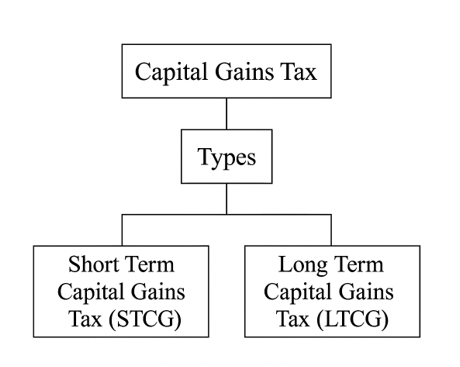
The types of capital gains are based on how long the asset is held before disposal. Typically, these are classified as 2 types:

Short-Term Capital Gains (STCG)

Short-Term Capital gains apply when the asset is sold in a short amount of time. The holding period depends on how the asset is held:

  • For listed shares and equity mutual funds, where sold in 12 months
  • For unlisted shares and properties, where sold in 24 months
  • For other assets, such as gold, bonds, etc., which were sold in 36 months

Compared to long-term gains, the tax rate on profits from such sales is higher. Recent changes have raised the STCG tax rates for mutual fund redemptions and listed equity shares in an attempt to prevent speculation and short-term trading.

Long-Term Capital Gains (LTCG)

If the asset is held over and beyond the short-term thresholds discussed above, any profit on the sale of the asset would be treated as a long-term capital gain. The holding periods are:

  • Over 12 months for listed equity shares and mutual funds
  • Over 24 months for unlisted shares and immovable property
  • Over 36 months for all other assets

LTCG will generally be taxed at lower rates than STCG. The only disadvantage is that for the sale of most assets, indexation will be eliminated for sales after July 23, 2024.

Capital Gains Tax Rates (FY 2025–26)

The tax rates that apply are shown below:

Asset Type  Holding PeriodTax Rate
Listed Equity Shares & Equity Mutual Funds  Short-Term (≤ 12 months)20% (previously 15%)
 Long-Term (> 12 months)12.5% on amounts above ₹1.25 lakh  
Unlisted Shares & Real EstateShort-Term (≤ 24 months)  Taxed as per slab
 Long-Term (> 24 months)  12.5% without indexation
Gold, Bonds, Debentures, Other AssetsShort-Term (≤ 36 months)Taxed as per slab
 Long-Term (> 36 months)  12.5% without indexation

Note: Because most long-term assets were sold after July 23, 2024, indexation has been removed.

Exemptions on Capital Gains Tax

The Income Tax Act has exemptions for reinvestment of capital gains in certain sections:

Section 54: Exemption on the sale of residential property if reinvested in another house.

Section 54F: Exemption on the sale of any long-term capital asset if the sale profits are reinvested in a house.

Section 54EC: Exemption allowed if the profits are invested in specified bonds within 6 months of sale.

The Capital Gains Account Scheme (CGAS) can be used to temporarily store the sale profits in case immediate reinvestment is not possible.

Conclusion

Capital Gains Tax (CGT) plays a vital role in wealth management and decision-making in investing. It is critical to understand the difference between short-term capital gains and long-term capital gains so tax liabilities can be planned accordingly.

With the recent tax changes, some careful investment planning and holding periods beyond short-term assets and all the exemptions as per the new laws may reduce tax liability.

TYPES OF ITR – INCOME TAX FORMS

Income Tax Return is referred to as ITR. Different Income Tax Return (ITR) forms have been provided by the Indian Income Tax Department for different taxpayer categories. Every form is made according to the taxpayer’s category and the type of income. For compliance, accurate tax assessment, and penalty avoidance, it is essential to file the correct ITR form.

An Income Tax Return (ITR) is a form that taxpayers submit to the income tax department stating their earnings and any necessary taxes.

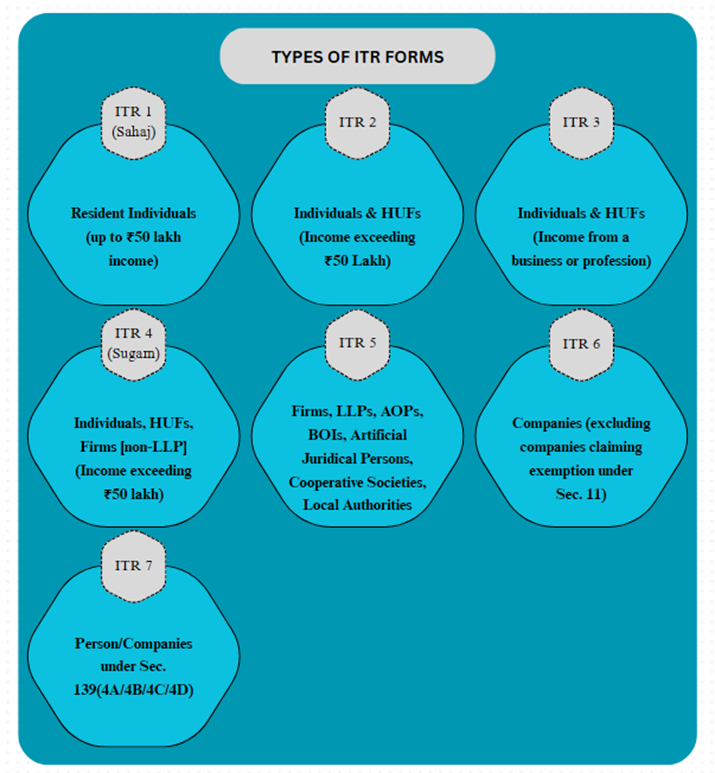
Till now, the department has issued seven forms. It is essential that all taxpayers submit their ITRs before the due date. ITR forms are applicable in many ways depending on the taxpayer’s income sources, income amount, and taxpayer category (individuals, HUF, firm, etc.).

ITR – 1 (SAHAJ)

The ITR-1 has been designed for residents with annual incomes up to ₹50 lakh. It can be applied if sources of income consist of:

  • Pension or salary
  • Income from a single property (unless there is a carried loss)
  • Other sources of income (not include prizes from horse racing or the lottery)
  • Income from agriculture up to ₹5,000
  • Section 112A allows for long-term capital gains of up to ₹1.25 lakh without carrying forward losses

However, anyone with business or professional income, multiple home properties, capital gains that exceed certain restrictions, overseas assets or income, directorship in a corporation, or investments in unlisted equity shares are not permitted to use ITR-1.

ITR – 2

Individuals and HUFs without business or professional income are subject to ITR-2. It works well if your earnings include of:

  • Pension or salary
  • Revenue from residential real estate, including multiple properties
  • Capital gains
  • Foreign assets and income
  • Agricultural earnings that exceed ₹5,000
  • Other sources of income, such as winners from horse racing and the lottery

If you have unlisted equity shares, are a Resident Not Ordinarily Resident (RNOR), are a non-resident, or are a director of the company, you must file an ITR-2. This form is not intended for people who make a living through their profession or company.

ITR – 3

Individuals and HUFs with business or professional income are required to file ITR-3. It includes the following:

  • Private businesses or occupations (where an audit is required or books of accounts are maintained)
  • Income from partnerships (as a partner in a firm)
  • earnings from capital gains, real estate, salaries, and other sources

ITR-3 is the appropriate form to use if your income comes from a proprietary business or occupation that is not subject to presumed taxes.

ITR – 4 (SUGAM)

Individuals, HUFs, and businesses (except from limited liability partnerships) that choose presumptive taxes under Sections 44AD, 44ADA, or 44AE and are residents are subject to ITR-4. It can be applied if:

  • Up to ₹50 lakh is the total income
  • Sections 44AD or 44AE are used to declare business income
  • Section 44ADA’s definition of professional income
  • income from a job, a single residence, or other sources (not including prizes from horse racing or the lottery)

This form is also available to freelancers with gross incomes up to ₹50 lakh. However, if you have income beyond ₹50 lakh, own foreign assets, or are a director of a corporation, you cannot use ITR-4.

ITR – 5

ITR-5 is meant for:

  • Firms
  • LLPs
  • AOPs (Association of Persons)
  • BOIs (Body of Individuals)
  • Artificial Juridical Persons
  • Estate of deceased or insolvent persons
  • Business trusts and investment funds

ITR-5 should be filed by entities that must report income, excluding corporations and trusts.

ITR – 6

Companies are regulated by ITR-6, with the exception of those that assert an exemption under Section 11 (charitable/religious reasons). This return must be submitted electronically by businesses using a digital signature.

ITR – 7

ITR-7 is used by institutions, political parties, trusts, and other organisations that must file returns under:

  • Section 139(4A): Trusts and legal obligations for charitable/religious purposes
  • Section 139(4B): Political parties
  • Section 139(4C): News agencies, scientific research associations, educational and medical institutions
  • Section 139(4D): Universities and colleges
  • Section 139(4E) & (4F): Business trusts and investment funds

WHY SHOULD YOU FILE ITR?

In addition to being required by law, submitting an ITR offers the following benefits:

  • helps in obtaining income tax refunds
  • Necessary for loan and visa applications
  • allows capital or commercial losses to be carried forward
  • serves as evidence of income
  • required for businesses, including those with little profit

CONCLUSION

The type of income, the taxpayer category, and the income level all affect which ITR form is appropriate. Rejection or penalties may follow the submission of an inaccurate form.

Here, this is just a brief about how to know which ITR Form is applicable to you based on your income structure. Consult your Tax consultant before opting for ITR Form or connect with us through

91-9267970588 or taxacumen.consultancy@gmail.com

Form 10 IEA: Choosing the Old Tax System Made Simple

The new tax regime under Section 115BAC(1A) and the old tax regime with deductions and exclusions are the two tax regimes that the Indian government permits salaried individuals and specific taxpayers to select between. The taxpayer must submit Form 10-IEA in order to keep the old regime.

What is Form 10-IEA?

The Income Tax Department introduced Form 10-IEA, a statutory declaration form. If a taxpayer wants to take advantage of deductions like the HRA, Section 80C benefits, standard deduction, etc., they can choose to stay under the old tax regime and avoid the default new one. This is particularly relevant for taxpayers who make money from their business or profession.

Who Should File Form 10-IEA?

Some taxpayers do not need to file Form 10-IEA. It is only required for Hindu Undivided Families (HUFs) and persons who:

  • Having earnings that are classified as “Profits and Gains of Business or Profession”, choose to stick with the old tax regime rather than the new tax regime that was implemented in AY 2024–2025.
  • It is not required for salaried individuals without company or professional income to file Form 10-IEA. When submitting their ITR, they have the option to select the previous regime directly. Nevertheless, the regime is only effective for that financial year after it is chosen.

Form 10-IEA: Why Was It Introduced?

Taxpayers previously opted for the new regime using Form 10-IE. However, the new tax regime is now the default choice starting in AY 2024–2025. Therefore, Form 10-IEA must be submitted by those who want to stay under the old regime.

By switching to a low-rate, no-exemption system, the government is attempting to simplify taxes while still providing flexibility to individuals who like common deductions.

The Procedure to File Form 10-IEA (Step-by-Step Guide)

Follow these simple steps to file Form 10-IEA online through the Income Tax e-filing portal:

Step 1: Log in on the e-Filing Portal

  • Visit: https://www.incometax.gov.in
  • Click on ‘Login’.
  • Enter your PAN, password, and captcha code.

Step 2: Go to Income Tax Forms

  • On the dashboard, click:
  • ‘e-File’ > ‘Income Tax Forms’ > ‘File Income Tax Forms’

Step 3: Search and Select Form 10-IEA

  • Scroll down or enter ‘Form 10-IEA’ in the search box.
  • Click ‘File Now’ next to the form.

Step 4: Select the Correct Assessment Year

  • Choose the assessment year for which you’re filing the return.
  • Example: For FY 2024–25, select AY 2025–26.

Step 5: Check Required Documents & Click ‘Let’s Get Started’

  • You’ll be shown a list of details needed to file the form.
  • Once ready, click ‘Let’s Get Started’.

Step 6: Declare Business/Profession Income Status

  • If you have income under “Profits and Gains from Business or Profession”, select ‘Yes’.
  • Select the applicable due date for filing the return, then click ‘Continue’.
  • Click the “Help Document” link for support with due dates.

Step 7: Confirm Your Regime Selection

  • Click ‘Yes’ to confirm you are opting for the old tax regime.

Step 8: Fill Out All 3 Sections of the Form

i. Basic Information

  • Your name, PAN, assessment year, and status will be auto-filled.
  • If this is your first time opting out, the “Opting Out” option will be selected by default.
  • If you have previously filed Form 10-IEA, the “Re-entering” option will be auto-filled.
  • Click ‘Save’.

ii. Other Information

  • This section requires you to declare whether you have any IFSC unit (under Section 80LA).
  • If applicable, enter IFSC details and click ‘Save’.
  • If you’re opting out of the new regime, this panel may be blacked out.

iii. Declaration & Verification

  • Review the declaration section carefully.
  • Tick the confirmation boxes and verify the details.
  • Click ‘Preview’ to check the entire form before submission.

Step 9: e-Verify the Form

Choose one of the methods below to e-verify:

  • Aadhaar OTP
  • Digital Signature Certificate (DSC) – required if under audit
  • Electronic Verification Code (EVC) via net banking or pre-validated bank account

Step 10: Submit the Form

  • After successful verification, click ‘Yes’ to submit the form.

Step 11: Acknowledgement

Once submitted, a success message appears on screen with:

  • Transaction ID
  • Acknowledgement Receipt Number
  • Keep these details for reference.

To download the submitted form, go to:

  • ‘e-File’ → ‘Income Tax Forms’ → ‘View Filed Forms’

Due date: According to Section 139(1) of the Income Tax Act, you must file Form 10-IEA prior to the deadline for filing your Income Tax Return (ITR). For the majority of people, this is July 31st after the financial year ends.

Absence of Compliance: If you do not submit Form 10-IEA by the ITR deadline, the system will presume that you are selecting the default new choice, and you will not be able to claim exemptions or deductions permitted under the previous regime.

Conclusion

Form 10-IEA is a crucial document for taxpayers who want to take advantage of common deductions and exemptions while maintaining the old tax regime. The government’s objective to provide flexibility while promoting a simpler system is reflected in it. ITR processing runs smoothly and eliminates unnecessary tax charges when it is filed accurately and on time. At filing time, knowing when and how to utilise this form can help you avoid problems and save money.