Company Audit – All Provisions here

Are you running Company, either, Private Limited or Limited or OPC? Do you know, irrespective of turnover amount, the Company needs place its Audited Financial statements before the stakeholders in AGM (Except OPC). OPC is exempted from holding AGM/EGM, But Audit is still need to be done and Annual filing of AOC 4 and MGT 7A are mandatory. Statutory Audit must be done, Turnover is not relevant here. Let’s Know more here about.    

One of the most important parts of Indian law that governs how companies’ function, handle their finances, and maintain transparency is the Companies Act of 2013. The audit provisions, which are primarily located in Sections 128 to 138, are among its significant features.

In order to safeguard the interests of creditors, shareholders, and other stakeholders, these regulations are intended to ensure that businesses keep accurate books of accounts and that these accounts are independently reviewed.

1. Section 128 – Books of Accounts

Section 128 requires every company to prepare and maintain proper books of accounts that give a true and fair view of the financial position of the company. These accounts must include records of:

  • All money received and spent.
  • All sales and purchases of goods and services.
  • Assets and liabilities of the company.

The books must be kept at the registered office of the company, although with board approval they can also be kept at another place in India. The law also allows companies to maintain accounts in electronic mode, which is in line with modern business practices.

Importantly, these records must be preserved for at least 8 years, ensuring that there is a proper history available for verification whenever needed.

2. Section 129 – Financial Statements

Section 129 deals with the preparation of financial statements. Every company has to prepare a financial statement at the end of the financial year that presents a true and fair view of the state of affairs of the company.

These statements include:

  • Balance Sheet,
  • Profit and Loss Account,
  • Cash Flow Statement,
  • Statement of Changes in Equity, and
  • Any explanatory notes.

Listed companies are also required to prepare consolidated financial statements for all their subsidiaries, joint ventures, and associates. These financial statements must comply with accounting standards notified by the government.

Small Company and One Person Company (OPC) are exempted to prepare the Cash Flow Statement.

3. Section 130 – Reopening of Accounts

Sometimes, there may be a need to reopen and revise accounts of a company. Section 130 allows this, but only under specific circumstances and with approval from the National Company Law Tribunal (NCLT). Reopening may be permitted if:

  • Accounts were earlier prepared fraudulently, or
  • Accounts are found to be incorrect due to mismanagement or other wrong practices.

This provision ensures that the integrity of financial statements is maintained and any wrongdoing can be corrected.

4. Section 131 – Voluntary Revision of Financial Statements

Apart from reopening, Section 131 allows companies to revise their financial statements or board’s report voluntarily, but only if they discover that the original filing did not comply with applicable laws. This revision requires approval from the Tribunal and can only be done once in a financial year.

5. Section 132 – National Financial Reporting Authority (NFRA)

Section 132 establishes the National Financial Reporting Authority (NFRA), which is an independent regulatory body that oversees auditing and accounting standards in India. NFRA has the power to:

  • Recommend accounting and auditing standards,
  • Monitor compliance,
  • Investigate professional misconduct of auditors, and
  • Impose penalties or debar auditors in case of violations.

The creation of NFRA has strengthened the audit system in India by making it more accountable and transparent.

6. Section 133 – Central Government and Accounting Standards

Section 133 empowers the Central Government to prescribe accounting standards in consultation with NFRA. This ensures uniformity and consistency in financial reporting across companies in India.

7. Section 134 – Approval of Financial Statements

According to Section 134, the Board of Directors is responsible for approving the financial statements before they are signed and submitted to the shareholders. Along with the financial statements, the Board’s Report is also prepared, which provides key information such as:

  • The company’s performance,
  • Details of loans, guarantees, and investments,
  • CSR activities, and
  • Director’s responsibility statement.

This section ensures that directors are held accountable for the financial health of the company.

8. Section 135 – Corporate Social Responsibility (CSR)

Although not directly part of the audit provisions, Section 135 requires certain companies (with a specific net worth, turnover, or profit) to spend at least 2% of their average net profits on CSR activities. The spending and reporting of CSR is also subject to auditing and disclosure norms.

9. Section 136 – Right of Members to Copies

Section 136 gives shareholders the right to receive financial statements and other reports at least 21 days before the annual general meeting. This ensures that members have enough time to review the company’s financial position before making decisions.

10. Section 137 – Filing with Registrar

Once approved, financial statements must be filed with the Registrar of Companies (RoC) within 30 days of the annual general meeting. Failure to comply attracts penalties on both the company and its officers.

11. Section 138 – Internal Audit

Finally, Section 138 makes provisions for internal audit. Certain classes of companies, as prescribed by rules, must appoint an internal auditor (a chartered accountant, cost accountant, or other professional) to check the internal controls and risk management of the company. This adds another layer of accountability and strengthens governance.

Conclusion

India takes corporate responsibility and transparency very seriously, as evidenced by the statutory provisions included in Sections 128–138 of the Companies Act, 2013. These sections address every facet of financial management and auditing, from internal audits to keeping accurate books of accounts. They increase trust among investors in the corporate sector in addition to protecting shareholders’ interests.

Such audit provisions are essential for ensuring that businesses operate responsibly and uphold financial integrity in a developing country like India.

BUSINESS TRUST – Concept and Income in the hands of Unit Holders

Business trusts such as Infrastructure Investment Trusts (InvITs) and Real Estate Investment Trusts (REITs) have become popular investment options in India because they allow investors to earn income from infrastructure and real estate projects. These trusts pool funds from investors, invest them in assets, and distribute the income generated to the unit holders. However, taxation of this income is a crucial aspect that every investor should understand.

What is a business trust?

A business trust is a special type of trust registered under SEBI regulations. It works as a pass-through entity, which means that the trust collects income from its investments and distributes it to its unit holders without paying tax at the trust level in most cases. Instead, the tax liability falls on the unit holders, subject to the provisions of the Income Tax Act, 1961.

Business trusts mainly earn income from three sources:

  1. Interest Income – earned from debt investments in Special Purpose Vehicles (SPVs).
  2. Dividend Income – received from SPVs where the trust holds shares.
  3. Rental Income – in the case of REITs, from leasing out real estate properties.

Taxation of Unit Holders

The taxation of unit holders depends on the type of income distributed by the trust. The key provisions under the Income Tax Act (specifically Sections 10(23FC), 10(23FCA), 115UA, and 194LBA) govern this area.

1. Interest Income

  • Interest distributed by the business trust is taxable in the hands of unit holders.
  • For residents, it is taxed at the applicable slab rate.
  • For non-residents, it is taxed at 5% (plus applicable surcharge and cess).

2. Dividend Income

  • A dividend is exempt if the SPV has not opted for the concessional tax regime under Section 115BAA.
  • If the SPV has opted for Section 115BAA, the dividend becomes taxable in the hands of the unit holder.

3. Rental Income (from REITs)

  • Any rental income received from leasing of property is taxable in the hands of the unit holders at their respective slab rates.

4. Capital Gains on Transfer of Units

  • Short-Term Capital Gain (STCG) on listed units (held for less than 36 months) is taxed at 15% under Section 111A.
  • Long-Term Capital Gain (LTCG) on listed units (held for more than 36 months) is taxed at 10% (without indexation) under Section 112A if gains exceed ₹1 lakh.

TDS Provisions

  • Section 194LBA requires the trust to deduct tax at source (TDS) before distributing income:

Interest: 10% for residents, 5% for non-residents.

Dividend: 10% for residents; for non-residents, rates as per DTAA.

Rental Income: 10% for residents; for non-residents, rates as per DTAA.

Why This Taxation System?

The pass-through structure is designed to avoid double taxation and make business trusts an attractive investment vehicle. If both the trust and the unit holders were taxed on the same income, it would reduce returns for investors. Therefore, the law ensures that most of the tax burden shifts to the unit holders.

Conclusion

Understanding the taxation of business trust income is important for investors to plan their taxes effectively. While business trusts provide steady income opportunities, investors should remember that different income streams attract different tax treatments. Staying updated on the latest provisions and judicial rulings is essential for compliance and effective tax planning.

Connect with us +91-9267970588 or taxacumen.consultancy@gmail.com to get professional advice on such income from business trust.

What is Advance Tax ? : A Short Guide

Although it is a necessary duty, paying taxes doesn’t have to be a stressful experience. Instead of paying their income tax all at once, taxpayers can use the Advance Tax system to even out their payments over the duration of the year. In addition to assisting the government in distributing tax revenue throughout the year, this approach guarantees improved cash flow management for both people and businesses.

What are advance tax payments?

Income tax paid in instalments before the duration, based on expected earnings for a particular year, is referred to as advance tax. Taxpayers pay in instalments according to the Income Tax Department’s timetable rather than waiting until March to pay the whole amount due.

This method applies to income from all sources—salary, business or profession, rent, interest, capital gains, or any other taxable earnings.

Who Is Responsible for Paying advance tax?

The following are subject to advance tax:

  • Salaried people who receive additional income from sources such as rent, capital gains, or interest from fixed deposits
  • Business owners and freelancers with a yearly tax liability of at least ₹10,000
  • Professionals having taxable income, such as physicians, attorneys, architects, and consultants

Exemption: Senior citizens who are 60 years of age or older who do not earn money from a business or profession are exempt from paying advance taxes.

Presumptive Taxation

In accordance with Section 44AD for businesses and Section 44ADA for professionals, taxpayers who choose presumptive taxation are required to pay all of their advance taxes in one lump sum by March 15th of the financial year. Additionally, they can pay by March 31st without facing penalties.

Due Dates of Advance Tax Due in FY 2025–2026

Regular taxpayers are required to pay advance tax in four instalments:

Due DateMinimum Tax to be Paid
15th June 202515% of total tax liability
15th September 202545% of total tax liability
15th December 202575% of total tax liability
15th March 2026100% of total tax liability

How Can Advance Tax Be Calculated?

  • Calculate the year’s total income from all sources.
  • Use permitted deductions and exemptions (e.g., Sections 80C, 80D, etc.).
  • Utilising the relevant tax slab, determine your tax liability.
  • Deduct any TDS that has already been taken out.
  • The remaining tax must be paid in installments as advance tax.

These calculations can be made easier with the use of a few internet resources, such as the calculator provided by the Income Tax Department.

How to Pay Advance Tax?

Advance tax can be paid in two ways:

Online: Go to the Income Tax e-filing portal, select Challan ITNS 280, and pay using net banking or debit card.

Offline: Go to an authorised bank and deposit the payment using a challan.

Always keep a copy of the payment receipt for your records.

Why On-Time Payment Is Important

Failure to pay advance tax on time results in interest under Sections 234B and 234C. These sections charge a monthly interest of 1% on the unpaid amount. Timely payments prevent these extra costs and keep your compliance record clean.

Advantages of Making Advance Tax Payments

  • prevents financial stress at the last minute.
  • keeps interest and penalties in check.
  • Simplify the yearly tax submission procedure.
  • encourages improved financial planning.

Conclusion

In addition to being required by law, paying taxes in advance is a wise financial move. You can evenly distribute out your tax liability, avoid fines, and have peace of mind during tax season by paying your taxes in advance. Estimating your revenue and making on-time tax payments is important for maintaining compliance and reducing stress, regardless of whether you are a business owner, freelancer, or salaried individual.

ITR Filing : Who Must File?

For all Indian taxpayers, filing an Income Tax Return (ITR) is an essential duty, not only a legal requirement. Compared to common perception, individuals who make taxable income are not the only ones who must file an ITR. Even if your income is less than the basic exemption threshold, there are a number of circumstances in which filing is required.

What is an Income Tax Return (ITR)?

To report your income, deductions, and taxes paid during a financial year, you must file an income tax return with the Income Tax Department. It guarantees openness, facilitates refund claims, and lets you carry your losses to subsequent years. In addition, filing an ITR provides official verification of income, which is frequently needed for government paperwork, loans, and visa applications.

Who Must File an ITR?

As per the provisions applicable for FY 2024-25, these are the main categories of people who must file an ITR:

1. Income Above Basic Exemption Limit

The most common reason for filing is income exceeding the exemption limit.

New Tax Regime (default): ₹3,00,000 for all taxpayers, regardless of age.

Old Tax Regime (if opted):

  • Below 60 years: ₹2,50,000
  • 60–79 years (Senior Citizens): ₹300,000
  • 80 years and above (Super Senior Citizens): ₹5,00,000

2. Claiming a Refund

If tax has been deducted at source (TDS) and you want to claim a refund, you must file an ITR.

3. Companies, Firms, and LLPs

All companies, firms, and LLPs must file an ITR, even if there is no income or business activity during the year.

4. Residents with Foreign Assets or Income

If you own foreign assets, foreign bank accounts, or earn income abroad, you must file an ITR regardless of your income level.

5. High-Value Transactions (As per Rule under Section 139(1))

Even if your income is below the exemption limit, you must file an ITR if you have:

  • Deposited ₹1 crore or more in current accounts during the year.
  • Deposited more than ₹50 lakh in savings accounts.
  • Spent ₹2 lakh or more on foreign travel.
  • Paid ₹1 lakh or more towards electricity bills.

6. Higher Business or Professional Receipts

You must file an ITR if:

  • Your business turnover exceeds ₹60 lakh, or
  • Your professional receipts exceed ₹10 lakh, or
  • Your TDS/TCS is ₹25,000 or more (₹50,000 for senior citizens).

7. Loss Carry Forward

If you have business or capital losses and want to carry them forward for future adjustment, you must file the return before the due date.

8. NRIs with Indian Income

Non-Resident Indians (NRIs) must file an ITR if they earn income in India exceeding the basic exemption limit.

Note: For NRIs, capital gains (short-term or long-term) from India do not get the basic exemption benefit. So even small gains make filing mandatory.

Why File an ITR Even If Not Mandatory?

  • Faster Loan and Visa Approvals: Banks and embassies require ITR as proof of income.
  • Claiming Refunds: A refund of excess TDS or advance tax is only possible if you file.
  • Official Record: ITR serves as legal proof of income.
  • Carry Forward Losses: Helps in future tax planning and reducing liability.

Penalties for Non-Filing

The due date for ITR filing for FY 2024-25 is September 15, 2025. Missing the deadline can lead to:

  • Penalty under Section 234F:
    • ₹5,000 for late filing
    • ₹1,000 if income is below ₹5 lakh.
  • Interest on unpaid taxes under Sections 234A, 234B, and 234C.
  • Possible prosecution for serious defaults.

Conclusion

Staying in compliance and maintaining financial control are more important for filing an ITR than just avoiding fines. Filing your return is necessary whether you have high-value transactions, overseas assets, exceed the income threshold, or are simply seeking a refund. The Income Tax portal has simplified the e-filing procedure, making it paperless, quicker, and easier.

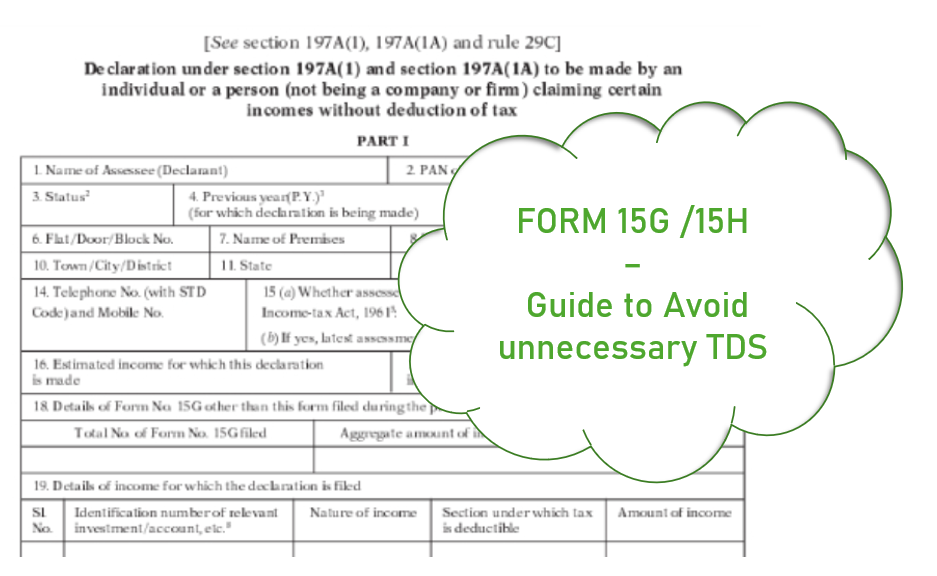
Form 15G and 15H: Simple Guide to Avoid Unnecessary TDS

Many taxpayers face situations where TDS (Tax Deducted at Source) is deducted from their income even when they do not have to pay any tax. Later, they have to claim a refund while filing the return. To avoid this hassle, the Income Tax Act allows eligible people to submit Form 15G or Form 15H.

These forms are self-declarations asking the payer (like banks, EPF offices, insurance companies, etc.) not to deduct TDS if your total income is below the taxable limit or your tax liability is nil.

What are Form 15G and Form 15H?

  • Form 15G is for residents below 60 years, Hindu Undivided Families (HUF), and certain trusts.
  • Form 15H is for resident senior citizens aged 60 years and above.

Both forms can only be filed by Indian residents. NRIs cannot use them. These forms can be submitted to banks and other tax deductor to ensure that TDS is not deducted where it is not applicable.

Who Can Use These Forms?

You can submit Form 15G if:

  • You are below 60 years.
  • Your total income is below the basic exemption limit (₹2.5 lakh in old regime, ₹4 lakh in new regime for FY 2025–26).
  • There is no tax payable on your total income.

You can submit Form 15H if:

  • You are a resident senior citizen (60 years or older).
  • Your tax liability is nil, even if interest income exceeds the exemption limit.

When and Where to Submit?

These forms must be submitted at the start of every financial year (preferably in April). This way, banks or other institutions will not deduct TDS throughout the year.

You can submit them:

  • To banks (for FD, RD, or savings interest)
  • To EPF authorities (for withdrawals before 5 years)
  • To companies (for bonds or dividends)
  • To post offices (for deposits)
  • To tenants (for rent subject to TDS)
  • To insurance companies (for commission or maturity proceeds)

Most banks also accept online submission via their website.

Where Are These Forms Useful?

These forms are commonly used to avoid TDS on:

  • Bank interest on FD/RD (Sec 194A)
  • EPF withdrawals (Sec 192A)
  • Rent (Sec 194-I)
  • Dividends (Sec 194, 194K)
  • Insurance commission (Sec 194D)
  • Life insurance maturity (Sec 194DA)
  • Corporate bond interest (Sec 193)
  • National Savings Scheme withdrawals (Sec 194EE)

Each of these has a specific threshold, beyond which TDS applies if forms are not submitted.

What If You Forget to Submit?

If you miss the deadline, TDS may still be deducted. However, you can:

  • File an Income Tax Return to claim the refund.
  • Submit the form later to stop further deductions for the rest of the year.

Filling the Forms – Step by Step

When filling Form 15G/15H, you need to:

  • Enter your name, PAN, and residential status.
  • Mention the financial year for which the form is being filed.
  • Declare your estimated income (interest, rent, etc.) where TDS applies.
  • State your total expected income for that year.
  • Provide investment details (FD numbers, bond details, etc.).
  • Sign the declaration confirming that your tax liability is nil.

Only fill this form if you meet the eligibility conditions. Filing a false declaration can lead to penalties and imprisonment under the Income Tax Act.

Penalty for False Declaration

If someone files these forms even when their income is taxable, it is considered a false statement. This may lead to:

  • Imprisonment (3 months to 7 years), and
  • Heavy fines, especially if the tax evaded is above ₹25,000.

So, be truthful while filing.

Conclusion

Forms 15G and 15H are simple forms to avoid unnecessary TDS deductions. They save you from the trouble of claiming refunds later. Submit them every year at the start of April, ensure all details are correct, and keep copies for records.

For seamless process, consult a tax expert or use online resources provided by banks and the Income Tax Department.

Step wise Guide for Freelancer to file ITR

Although freelancing gives you great flexibility and independence over the work you do, it also includes the responsibility of managing your taxes on your own. In comparison with salaried workers who receive Form 16 and employer support, freelancers are responsible for monitoring their own earnings, expenses, and compliance deadlines.

In addition to avoiding penalties, filing your Income Tax Return (ITR) accurately is essential for maintaining your credit score, claiming deductions, and ensuring future loans and credit can be obtained easily. Although tax filing as a freelancer may appear difficult at first, it is easy with the correct strategy.

Who Needs to File ITR as a Freelancer?

Freelancers are considered those who make money under the Income Tax Act’s “Profits and Gains from Business or Profession” category. You fit into this category if you are self-employed and make money from your skills, services, or consulting.

An ITR must be filed if:

  • The basic exemption (₹2.5 lakh under the previous regime and ₹3 lakh under the new regime for FY 2024–25) is exceeded by your yearly income.
  • You could be subject to a tax audit if your gross receipts are over ₹50 lakh (or ₹75 lakh if your cash receipts exceed 5%).
  • You want the extra TDS that your clients deducted to be refunded.
  • You are making an advance tax payment, which is required if your yearly tax liability is more than ₹10,000.

Applicable ITR Forms

  • ITR-3: For freelancers filing income under standard rules.
  • ITR-4 (Sugam): For those applying for the Presumptive Taxation Scheme under Section 44ADA, where 50% of gross earnings are treated as taxable income.

Step-by-Step Procedure for Filing ITR as a Freelancer

Even if the procedure could seem complicated, it is simple to follow when it is divided into different steps:

Step 1: Collect All Income Records

Gather bank statements, invoices, payment receipts, and any TDS certificates (Form 16A) that you may have received from clients. The basis of error-free filing is accurate income reporting.

Step 2: Calculate Net Taxable Income

The rent for a home office, internet, utilities, travel expenditures, professional devices, and software subscriptions are all examples of expenses that freelancers can deduct from their total income. This provides your net income, which is used for calculating taxes.

Step 3: Claim Allowable Deductions

You can reduce taxable income more by claiming deductions under multiple sections:

  • 80C: Investments in PPF, ELSS, life insurance, etc.
  • 80D: Health insurance premiums.
  • 80GG: Rent paid if you don’t receive HRA.
  • 80G: Donations to eligible institutions.

Also, business-related expenses are fully deductible if they are used only for your freelancing work.

Step 4: Log in to the e-Filing Portal

Go to www.incometax.gov.in and log in using your PAN (which is used as your user ID). Select ‘File Income Tax Return’ and choose the applicable assessment year (AY 2025–26 for FY 2024–25).

Step 5: Select the Correct ITR Form

  • Use ITR-3 if filing under standard provisions.
  • Use ITR-4 if applying for presumptive taxation under Section 44ADA.

Selecting the correct form assures hassle-free processing.

Step 6: Fill in Income and TDS Details

Enter your entire income from freelancing, deductions, and any TDS that clients already deducted. Some information is automatically filled in Form 26AS, AIS, and TIS by the system, but you still need to double-check it.

Step 7: Calculate Tax and Pay Any Remaining Balance.

Your total tax liability will be calculated by the portal after all data has been entered. If taxes are due, use Challan ITNS 280 to make the payment online. Interest under Sections 234B and 234C can be avoided with timely payment.

Step 8: Submit and Verify ITR

Finally, within 30 days, mail a signed ITR-V form to the CPC Bengaluru, or electronically submit your return and get it verified using Aadhaar OTP or net banking. Your return will be considered invalid if it is not verified.

ALso, click here to know about Income tax compliances for freelancers https://taxacumen.in/?p=1179

Conclusion

As a freelancer, filing an ITR is not only a legal requirement; it is also an important part of managing your finances. You may claim refunds, avoid penalties, and maintain a clean financial record that enhances your credibility by submitting on time and accurately. You can manage tax compliance with credibility if you maintain complete records, take benefit of deductions, and follow the straightforward procedures mentioned above.

It is advisable to consult your tax advisor for better understanding to avoid heavy penalties for wrong filing, wrong deduction, mismatch values.

You can connect us

WhatsApp : +91-9267970588 Email I’d:taxacumen.consultancy@gmail.com

Follow us here: https://whatsapp.com/channel/0029VaXqUTnL2AU3Z1yxXD3S

Tax Implications and Exemptions on Gifts in India

Giving gifts is a beautiful way to show someone you care, develop relationships, or provide financial help. Giving gifts is popular in both personal and cultural contexts in India, whether it’s money from parents, a wedding present from a friend, or a piece of inherited wealth. Many people are unaware, however, that the Income Tax Act may impose taxes on specific gifts.

In the financial year 2025–2026, it is important to know how the Income Tax Department handles gifts and when they become taxable if you are giving or receiving one in India.

What is gift tax?

Section 56(2)(x) of the Income Tax Act, 1961, governs gift tax in India. A specific Gift Tax Act was there, but it was repealed in 1998. Presently, the income tax regulations deal with the taxability of gifts. According to these regulations, any amount of money or property that an individual or Hindu Undivided Family (HUF) receives as a gift or without payment may be taxed as “Income from Other Sources.”

When are gifts taxable?

According to current legislation, gifts are only considered taxable if they are given without sufficient consideration and have a total worth of more than ₹50,000 throughout a financial year. There is no tax liability if the value is less than ₹50,000.

The taxation of various gift categories is as follows:

Type of Gift  Threshold for TaxTaxable Amount
Cash or chequeAbove ₹50,000The entire amount becomes taxable
Immovable property (without consideration)Stamp Duty Value > ₹50,000Stamp Duty Value is taxed
Immovable property (for insufficient consideration)If difference > ₹50,000The difference is taxed
Movable property (like jewellery and shares) without considerationFair Market Value > ₹50,000FMV is taxed
Movable property for insufficient considerationFMV – Paid amount > ₹50,000The difference is taxed

It should be noted that if you receive several small gifts, the entire amount—not just the excess—becomes taxable once their combined value exceeds ₹50,000.

Who is exempt from gift tax?

Not every gift is subject to taxes. Depending on the event or relationship with the giver, the Income Tax Act offers several exclusions. You are exempt from paying gift tax in the following situations:

1. Presents from Specified Family Members (Totally Exempt)

The following family members’ gifts are completely exempt from taxes:

  • spouse
  • siblings of one’s own or their spouse
  • Parents or parents-in-law
  • Lineal descendants or ascendants, such as parents, kids, grandparents, and grandchildren
  • spouses of the aforementioned relatives

2. Gifts on Special Occasions (which are exempt regardless of the sender)

  • One’s marriage (Remember, nobody else is exempt—just the bride and groom.)
  • In a will or by inheritance
  • After the death of the giver
  • Division of HUF among participants
  • From municipal governments, charitable trusts that are registered, or organisations that fall under Section 10(23C), 12A, or 12AA

An Example of a Gift of Immovable Property

Suppose a friend (not a family member) gives you a piece of land. ₹3,00,000 is the stamp duty value. You are liable for the full ₹300,000 since it is from a non-relative and exceeds ₹50,000.

Regardless of the property’s worth, there is no tax if you receive it from your mother.

The advantage of documentation

It is generally preferable to use a gift deed to record the transaction when handling expensive gifts, particularly when:

  • A relative gave you the gift, and you have to prove your relationship with them.
  • Either immovable or movable wealth is the form of gift.
  • In the future, tax authorities might examine or ask you.

To prevent issues later, a straightforward, notarised gift deed that includes the date, the gift’s specifics, and the reason for it can be used as proof.

Conclusion

Receiving a gift is joyful, but in order to prevent future legal or financial issues, it’s crucial to understand its tax implications. Gifts from family or for a wedding are completely exempt, as are most kinds of sincere gestures. However, you might have to account for them in your tax calculations if you’re getting property or gifts from non-family members that are significant in value.

It is always advisable to consult an expert before accepting and showing any such transaction. For any query, Connect with our team at 91-9267970588 or taxacumen.consultancy@gmail.com

All About Form 26AS and Annual Information Statement (AIS)

Transparency and digitalisation are now essential elements of efficient compliance in India’s changing tax system. Form 26AS and the Annual Information Statement (AIS) are two of the most important tools the Income Tax Department has provided to help people manage their tax responsibilities. Their scope, structure, and purpose differ, but they both aim to record and present a comprehensive record of a taxpayer’s financial and tax-related activities.

What is Form 26AS?

A combined annual tax statement associated with a taxpayer’s PAN (Permanent Account Number) is called Form 26AS. It records every tax-related detail, including advance tax payments, self-assessment taxes, refund information, high-value transactions, and TDS (Tax Deducted at Source) and TCS (Tax Collected at Source). This declaration guarantees that any taxes collected or withheld on behalf of a taxpayer are properly submitted to the government and listed under their PAN.

If a taxpayer’s PAN is connected to their bank account, they can access or download Form 26AS via the TRACES website or through net banking.

Details are given in Form 26AS

The following information is included in Form 26AS:

  • TDS and TCS from rent, professional fees, salaries, or real estate sales.
  • Direct payment is made for advance and self-assessment taxes.
  • Refunds of income taxes are credited throughout the financial year.
  • high-value transactions, such as real estate sales and mutual fund acquisitions.
  • turnover of GST (as seen in GSTR-3B).
  • TDS/TCS submission delays or defaults.

Starting in FY 2022–2023, Form 26AS has been divided into 10 sections, each of which focuses on a distinct area of your tax information, ranging from TDS on interest and salary to transactions involving virtual digital assets and cryptocurrencies. Sections with similar but wider scope were titled Part A to Part H in previous releases (up to FY 2021-22).

What Makes Form 26AS Important?

  • Tax Credit Validation: This acts as a tax credit statement to assist taxpayers in making sure that the TDS that banks, employers, and other entities collected is deposited accurately.
  • Cross-Verification using Form 16/16A: This helps confirm that your TDS certifications are accurate.
  • Proper ITR Filing: It lowers the possibility of receiving notices and helps ensure that the right tax credit is reported in the Income Tax Return (ITR).
  • Check Refund Status: You may also find out when and if you received your income tax refund.

The Annual Information Statement (AIS)

The Income Tax Department introduced the Annual Information Statement (AIS) to provide data in more detail and openness. Compared to Form 26AS, AIS provides a more thorough and detailed summary of a taxpayer’s financial transactions.

In addition to all of the information from Form 26AS, it also adds:

  • Foreign remittances
  • Off-market share transactions
  • Break-up of salary
  • Interest earned on tax refunds
  • Dividend receipts
  • Information derived from others’ ITRs (e.g., buyer details reported by property sellers)

Taxpayers can access the AIS using the income tax e-filing system and report inaccurate information. This is an important step because it gives taxpayers the ability to raise concerns before such information is taken into account when making tax assessments.

Form 26AS vs AIS: Key Differences

AspectForm 26ASAnnual Information Statement (AIS)
ScopeTax-related detailsFinancial and tax-related transactions
Data SourceTDS, TCS returns, refund infoIncludes additional sources (banks, depositories, ITRs of others)
Feedback MechanismNot availableTaxpayers can submit corrections or discrepancies
Download LocationTRACES portalIncome Tax e-filing portal
Use in ITR FilingEssentialSupplementary/confirmatory

Note: In case of discrepancy, Form 26AS prevails over AIS, as per the CBDT press release, unless the taxpayer has strong data to support corrections in AIS.

How to Access Form 26AS and AIS?

To view Form 26AS

  • Go to https://www.incometax.gov.in and log in.
  • Select Income Tax Returns under e-File. Examine Form 26AS.
  • To view or download the statement, you will be taken to the TRACES portal.

To view AIS:

  • Open the income tax portal and log in.
  • Navigate to the Annual Information Statement (AIS) under “Services.”
  • See or obtain the Taxpayer Information Summary (TIS) and AIS.

Conclusion

Every taxpayer should understand and frequently review Form 26AS and AIS. When viewed by the Income Tax Department, these records work as a mirror reflecting your financial and tax transactions. They help you avoid tax notices, interest, or fines in addition to making sure your ITR is filed accurately.

ITR FILING for FREELANCERS: All about Compliances

Freelancers can work freely, decide their employment, and make money without being restricted by an employer when they work independently. But this independence also means that you have to handle your taxes on your own. Freelancers do not have an employer to withhold and deposit taxes, in comparison to salaried employees. As a result, they have to manage tax compliance on their own, from keeping track of their earnings to filing their Income Tax Return (ITR).

It’s important to understand how ITR filing works in order to prevent penalties, make permitted deductions, and maintain a clean financial record.

Who Is Considered a Freelancer for Tax Purposes?

An individual’s earnings from self-employment, skilled work, or artistic skills are subject to taxation under the Income Tax Act of 1961 under the category of “Profits and Gains from Business or Profession.”

Common examples of freelancers include:

  • Bloggers, developers, designers, and content creators
  • Photographers, trainers, teachers, and consultants
  • Professionals such as independent accountants, doctors, advocates, and architects

You are considered a freelancer and are required to file an ITR if you earn money on your own (rather than as a wage).

Which ITR Form Applies to Freelancers?

The selection of the right form is the first step in ITR filing:

  • ITR-3: Suitable when income is from business or profession without applying for presumptive taxation.
  • ITR-4 (Sugam): Used when applying for the Presumptive Taxation Scheme under Section 44ADA, where 50% of the net income is considered taxable. This is allowed if your annual income is up to ₹75 lakh, with cash transactions not exceeding 5%.

Tax Slabs for Freelancers (AY 2025–26)

Freelancers can choose between:

  • Old Tax Regime (with deductions)
  • New Tax Regime (default, with lower rates but limited deductions)

Click the link to know the Tax Slabs under OLD and NEW TAX Regimes https://taxacumen.in/?p=1056

Deductions Freelancers Can Claim

In case, Freelancers opt for OLD TAX REGIME, there are some deductions to lower their taxable income even though they are not eligible for salary-based exemptions like HRA:

  • Section 80C: Investments in PPF, ELSS, life insurance, etc. (limit ₹1.5 lakh).
  • Section 80D: Premiums paid for health insurance.
  • Section 80E: Interest on education loans.
  • Section 80G: Donations to eligible charitable institutions.
  • Section 80GG: Deduction for rent paid if no HRA is claimed.
  • Business Expenses: Expenses directly related to freelancing, such as home office rent, internet bills, professional equipment, and travel expenses, can be deducted.

These deductions are important for reducing your overall tax liability.

TDS and Advance Tax for Freelancers

Freelancers need to understand their advance tax and TDS obligations as well.

Tax Deducted at Source (TDS): In accordance with Section 194J, clients often deduct 10% TDS from payments. This TDS can be claimed when filing your ITR.

Advance Tax: You must make four payments of advance tax if your total tax liability in a financial year exceeds ₹10,000.

  • 15th June – 15% of tax
  • 15th September – 45% of tax
  • 15th December – 75% of tax
  • 15th March – 100% of tax

Non-payment of advance tax results in interest under Sections 234B and 234C.

Important Due Dates for Freelancers (FY 2024–25)

  • Advance Tax Instalment – 15th June, 15th September, 15th December, and 15th March
  • ITR Filing Deadline31st July 2025 (for non-audit cases). The deadline has been extended till 15th September 2025 for the current year only.

Sticking to these deadlines ensures smooth compliance and avoids unnecessary penalties.

Conclusion

Once you understand the basics, filing an ITR as a freelancer is not as difficult as it seems. You can simply maintain compliance by keeping track of your earnings and expenses, selecting the correct ITR form, and making on-time advance tax payments.

Additionally, timely ITR filing improves your financial credibility, helps in refund claims, and simplifies future loan or visa procedures. To take benefits, consider tax filing as a component of your career development and, if necessary, get advice from a tax professional.

Here, this is just a brief about how to know about tax liability, rate slabs, etc for Freelancer. It is also better to consult your Tax consultant before filing ITR

For any further query, connect with us through 91-9267970588 or taxacumen.consultancy@gmail.com

HRA Exemption – Practical Aspects and Method of Calculation

One of the most popular salary components that offers tax advantages to salaried workers residing in rental housing is the House Rent Allowance (HRA). Even while many employees receive HRA, not everyone is aware of how to properly claim it or determine the amount that is exempt under the 1961 Income Tax Act. Reducing taxable income and maintaining compliance during tax filing are made easier by being aware of the practical implications of the HRA exemption.

What is HRA Exemption?

HRA is an allowance given by employers to employees to cover their rental expenses. Under Section 10(13A) of the Income Tax Act and Rule 2A of the Income Tax Rules, employees can claim exemption on the HRA received, with regard to certain conditions.

Only salaried individuals who live in rented houses and pay rent can claim this exemption. Self-employed individuals cannot avail of HRA benefits.

Conditions to Claim HRA Exemption

  • You must be a salaried employee.
  • You should actually pay rent for the house you live in.
  • Rent must be paid to the owner; if paid to a family member, proper documentation is required.
  • PAN of the landlord is mandatory if rent paid exceeds ₹1 lakh annually.
  • HRA exemption is available only if you do not own the residential property in the city where you work.

How to Calculate HRA Exemption?

The exempt portion of HRA is calculated as the least of the following three amounts:

  • Actual HRA received from the employer.
  • Rent paid minus 10% of salary (basic + DA, if applicable).
  • 50% of salary if living in a metro city (Delhi, Mumbai, Chennai, or Kolkata) or 40% of salary if living in a non-metro city.

The remaining HRA, if any, is taxable.

Example of HRA Calculation

Suppose:

  • Basic Salary: ₹40,000 per month
  • HRA Received: ₹18,000 per month
  • Rent Paid: ₹15,000 per month
  • City: Mumbai (Metro)

Step 1:
10% of salary = ₹4,000 × 10% = ₹4,000

Step 2:
Rent paid – 10% of salary = ₹15,000 – ₹4,000 = ₹11,000

Step 3:
50% of salary (for metro) = ₹20,000

Exempt HRA = Least of ₹18,000, ₹11,000, and ₹20,000 = ₹11,000
Thus, ₹11,000 is exempt, and the remaining ₹7,000 is taxable.

Points to Remember

  • If you pay rent to your parents, you can claim HRA, but they must show the rental income in their return.
  • If rent is more than ₹50,000 per month, TDS at 5% needs to be deducted and deposited by the tenant.
  • Rent receipts or rent agreements may be required as proof while claiming HRA.
  • HRA exemption is available under both the old tax regime and the new tax regime?
  • Old Regime: Available.
  • New Regime (Section 115BAC): HRA exemption is not available.

HRA and Home Loan – Can You Claim Both?

Yes, if you live in a rented house and own another house in a different city (or if the owned house is under construction or rented out), you can claim both HRA exemption and home loan interest deduction under Section 24(b). However, proper documentation is necessary to avoid scrutiny.

Documents Required to Claim HRA

  • Rent receipts signed by the landlord.
  • Rent agreement (if applicable).
  • PAN of landlord (mandatory if rent exceeds ₹1 lakh annually).
  • Proof of rent payment (bank transfers, receipts).

Mistakes to Avoid

  • Claiming HRA without actual rent payment.
  • Not maintaining rent receipts or proper proof.
  • Providing incorrect landlord details.
  • Trying to claim HRA while living in self-owned accommodation in the same city.

Conclusion

A good tax-saving option is the HRA exemption, but it needs to be properly calculated and claimed. Making the most of this benefit without violation of the law under inspection is ensured by being aware of the calculating formula, keeping accurate records, and adhering to the law.

Knowing these useful aspects helps salaried people in filing their taxes and helps them avoid mistakes when submitting their ITR. It’s always a good idea to speak with a tax professional if your HRA calculation looks unclear.