How To Avoid GST Penalties

One aspect of managing a small or medium-sized business in India involves dealing with taxes. Furthermore, a single missed deadline or thoughtless error could cost you more than you expected when it comes to GST (Goods and Services Tax). In addition to being irritating, late filing penalties can reduce your profits and perhaps prevent you from receiving your input tax credit.

The good news? In reality, avoiding GST fines is rather simple. You can prevent needless spending and stay within the law with a little preparation, a few habits, and knowledge of the rules.

1. Know the GST schemes available for small businesses

GST Law provides various benefits to small businesses such as exemption from registration within limit, special concession rates for composition dealers, QRMP Scheme, etc.

Small businesses can avail such schemes only when they know about such schemes. Many times, business turnover limit exceed the basic exemption from registration, but the small business owners avoid the registration initially due to negligence, no knowledge about limit, etc.

It results into the heavy penalty and interest demand at one go, which is quite disturbing to the small businesses. Ask the expert to avail such benefits.

2. Know the Penalties You May Face

You have to first understand what penalties are involved to avoid them. There are two typical penalties under the GST law:

  • When returns are filed after the deadline, there is a per-day late fee.
  • The other is interest; you will be assessed 18% annual interest if you fail to pay your taxes on time.

If you file your GSTR-3B ten days after the due date, you may be fined a late fee of ₹500 (50 per day) for a standard return. It is ₹200 (₹20 each day) if it is a NIL return. You will also have to pay interest if you owe taxes.

For instance, you pay ₹500 as a late fee and around ₹1,000 in interest if you miss a ₹1 lakh tax payment by ten days.

3. Avoid Ignoring NIL Returns

You must still file a NIL return even if your business has no sales or purchases during the month. Many entrepreneurs believe there is no need, yet it is an expensive error. Skipping a NIL return carries a penalty of ₹20 per day. That quickly builds up over time.

4. File early and keep due dates at touch

What is the main cause of penalties for the majority of businesses? Holding off until the very last moment. Due to high traffic, the GST portal frequently lags or even fails close to deadlines. You can avoid technical issues and the anxiety of delays by filing merely two or three days early.

Put the dates of the GST payable in your calendar:

GSTR-1: For sales reporting

GSTR-3B: For payment and tax summary

GSTR-9: Annual Report

GSTR-4: If the composition scheme applies to you

5. Before filing GSTR-3B, use GSTR-1A to fix any errors

GSTR-3B will be automatically filled by using GSTR-1 as of July 2025. Direct editing of GSTR-3B will no longer be possible. Therefore, before reporting GSTR-3B, correct any errors in your sales data using the updated GSTR-1A.

Important: every time you are only allowed to make one change. Therefore, review your entries one more time before submitting them.

6. Monthly Invoice Balancing

A minor discrepancy between your invoices could eventually cause a major issue. Your ITC may be disallowed if your purchase information differs from the filings made by suppliers.

Every month, set aside enough time to:

  • Compare purchase and sales records.
  • Check GSTINs and invoice numbers.
  • Verify the quantities and tax rates.

You can avoid mistakes during audits or annual returns by keeping everything organised month after month.

7. Don’t Depend on Your Accountant Excessively.

It’s great if you’ve involved a certified public accountant or a GST expert to submit your returns, but don’t check out entirely. Eventually your filings are your responsibility.

What you can do:

  • Request summaries of the returns.
  • A copy of the filing acknowledgement should be kept.
  • Consult your consultant to confirm deadlines.

8. Automation, if possible

These days, there are numerous helpful GST filing ideas available:

  • Set alerts for deadlines.
  • Track return status
  • Auto-reconcile invoices.
  • Calculate late fees and interest if you’re delayed.

Automation takes the pressure off and reduces chances of manual mistakes.

9. Organise your digital records

Make folders for every month, either on your computer or in the cloud. Keep track of your invoices for purchases, sales, ITCs, and payments. Everything will be simple to reach when it’s time to file, and your work will be quicker and free of errors.
GST REGISTRATION PROCESS in INDIA

Any person falling under the laws of GST must need to get registered under the GST and have the GSTN. Click the link here to know, whether you are falling within limit GST registration threshold limit, https://taxacumen.in/?p=978 and to understand the benefits of the same https://taxacumen.in/?p=986

Here, we will not discuss again whether you are required to have GST or not, but to know step-by-step registration process to apply for the same.

Step 1

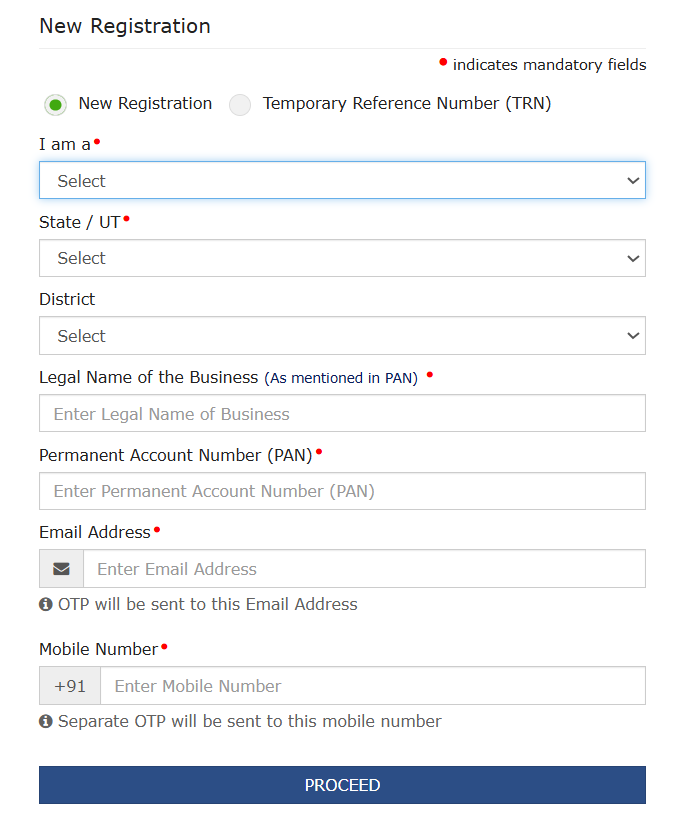
Go to the Website https://www.gst.gov.in/ and to register, go to the “Register” tab on the Right side in Top location. If you are here for the first time go to “New Registration” and if you already have TRN, Click to TRN.

Step 2

You will get to watch the screen as mentioned here, fill the details asked here to proceed when you dont have TRN already

Select whether you are  Taxpayer, Input Service Distributor(ISD), Tax Deductor, Tax Collector (Ecommerce Operators), Non Resident Taxable Person, GST Practitioner, or else.

Also, mention your legal name as per Permanent Account Number (PAN) only, Business Name can be differ.

Mention your email Address and Mobile number for OTP and all future correspondence with the GST Department. Make sure to provide active email and mobile number.

And after filling all the details and information here, Click on Proceed to reach the next page.

Step 3

You will receive a page to enter a valid OTP, here Email and Mobile OTP will be the same. You can check and mention any of them to proceed.

Step 4

Once the OTP you entered above verified and approved, you will get this Screen, where TRN (Temporary Reference Number) will be mentioned for you. 

Save the TRN and write it down to your notepad for future correspondence. You will also get the said TRN through the text in messages and in your email mentioned in the application.

Step 5

Now, you have TRN with you to proceed for GST Registration. You must know that TRN will be available for 15 days to complete the process with the same TRN. Otherwise, a new TRN will be required.

Now you will login the Portal with your Received TRN and OTP to be received through your email and mobile both. After entering the OTP, you will be reached at a page where your Draft application is being shown.

Step 6

Here, you must complete this draft application within 15 days from generating the TRN. Till the date you didn’t get a GST Number from the GST Department, you can login with TRN for your registration.

Step 7

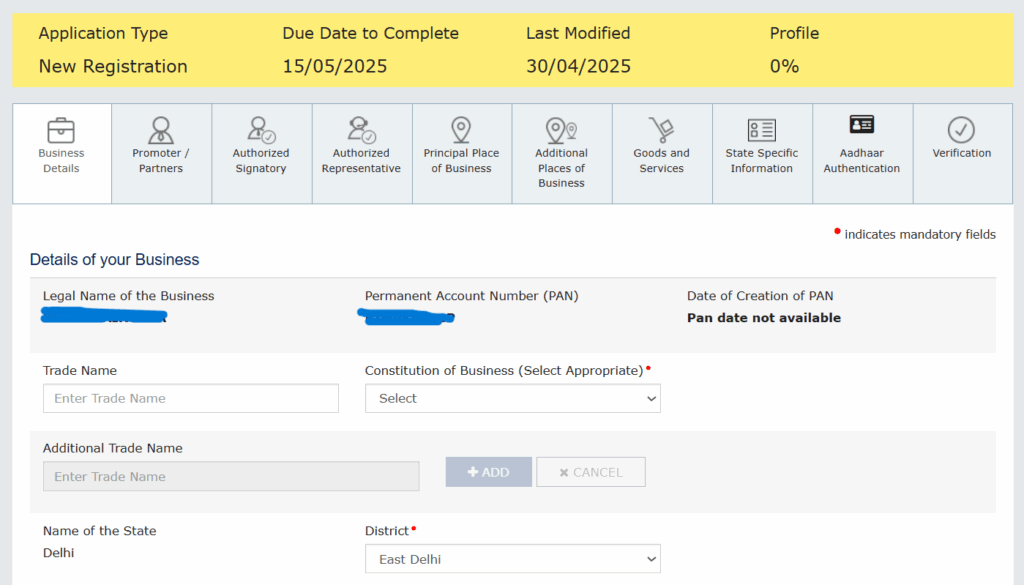
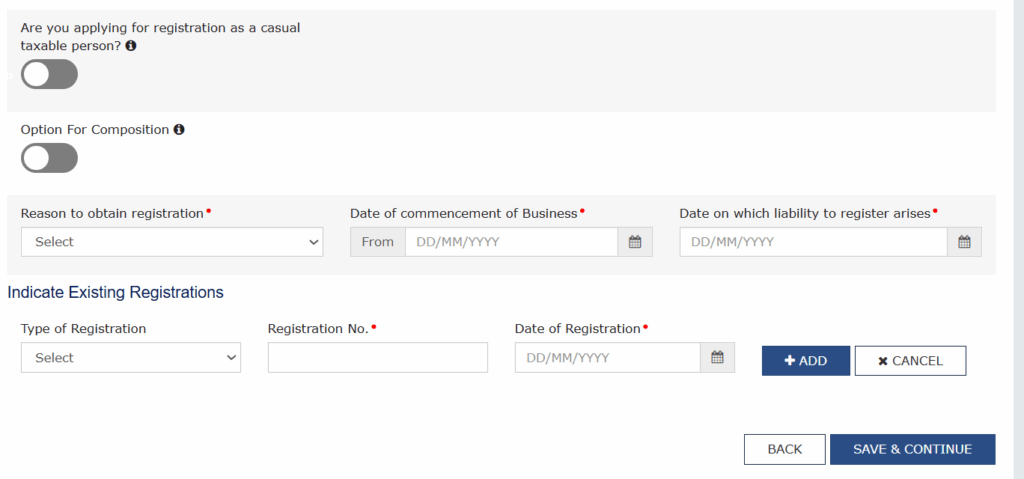
Here, you must provide Trade Name of business, Address details and proof of premise where the business is being operated, Personal details of Proprietor/Partners/Directors, Documentary proof of any additional premise for business to be attached, and all the details asked in the draft form must be provided. 

Here in the image, this is only first page of the draft form. The Applicant must complete the entire draft application, then Profile completion % mentioned in the right side of the image will be shown as 100%

Step 8

Aadhaar Authentication process

After the completion of the draft form, verification process is being done according to rules and provisions. There is an option to do Aadhaar Authentication with biometric verification of the primary authorized person. Where the mobile number of the primary responsible person used for registration is the same number with which Aadhaar has been linked, it is possible to authenticate the Aadhaar online with OTP. It cuts the time process of approval from the department within 7 days. 

Also, where a person opts to not to authenticate Aadhaar as described here before, he/she  can upload an Aadhaar copy to complete the KYC process. In such case, the GST Officer must verify the principal place of business physically and the time limit to approve the GST Registration Application is within 30 days.

It is advisable and beneficial to do Aadhaar authentication with biometric verification for GST Registration.

Step 9 

Approval of GST Application

Once the department is satisfied with all the details mentioned here and documents attached, the application will be approved. The applicant will receive an automatically sent mail having the login credentials in it.

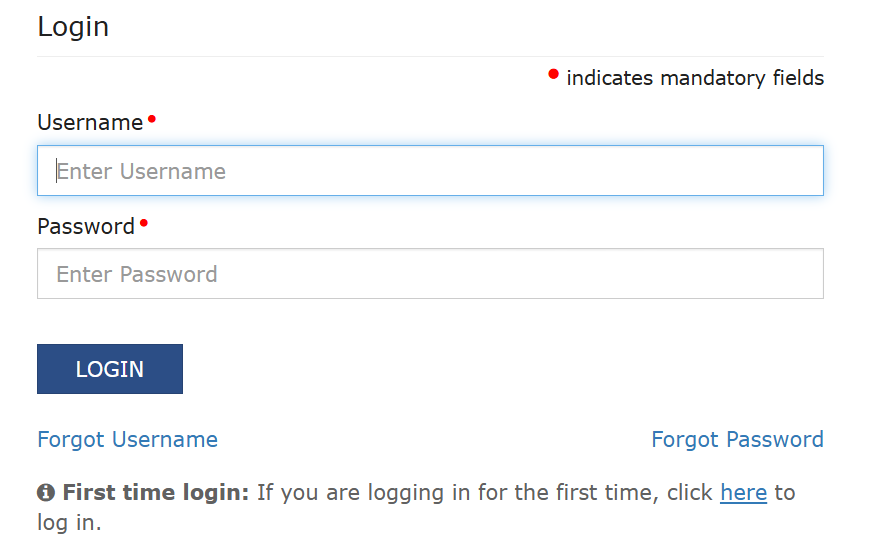
Login path for First time users must be used, Here, Create the User Id ( not changeable) and change the system password given by the department through the mail.

Step 10 

Bank Account Update

Generally people thinks GSTN is received and work is done. But, this is untrue. The registered taxpayer must add their bank details with a cancel cheque or bank passbook first page mandatorily within 45 days from the date of registration granted.

In case of non compliance, the department can cancel the GST Registration after the deadline passed.

About Author – Deepa Kaintura

I am a lawyer by profession. I am a legal consultant in TaxAcumen providing services to corporates about GST, Income Tax, ROC Compliances, etc. My love for finance and law encouraged me to write and share the knowledge with the readers here. For any query, reach us at 

WhatsApp : +91-9267970588 Email I’d:taxacumen.consultancy@gmail.com

BENEFITS OF GST REGISTRATION IN INDIA 

In GST (Goods and Service Tax) Laws, GST Registration is not required to be done for all the people who are engaged in some kind of business and other activities. 

In General, GST Registration is considered as a primary requirement for doing the business, but this is not the case. To know more about and check the applicability and threshold concept in GST Law, Click here https://taxacumen.in/?p=978

There are many activities which are not to be taxed under GST and also, there is an exemption to register according to threshold limit and place of business. 

In spite of the threshold limit, any business entity can voluntarily get itself registered under the GST Laws but once it gets registered, all the provisions, rules and regulations are binding upon and must be complied with.

Here, we will talk about the benefits of getting a GST Number whether or not, taken voluntarily or in other cases.

BENEFITS OF GST Registration in India

  1. Availability of ITC Claim for Tax Payer

A business who pays GST on input services and goods, subject to  availability as per law, can claim the said GST Paid as ITC ( Input Tax Credit). Without GST, the same GST Paid is to be added to the cost of operations and no ITC can be claimed. 

  1. Composition Scheme 

Small Business owners are being allowed to pay lower rates of GST and to be known as composite Dealers with some restrictions and some benefits as well. Small Business with Turnover upto 1.5 Crore / 75 lakhs, can get the benefit under this scheme. Not all documents are required to be maintained. But NO ITC is allowed to businesses using this scheme and they must not claim any ITC. Cash is to be paid for the same.

  1. Simplified Tax System

Before July 2017, business entities must comply and ensure proper documentation and working as per many indirect tax laws such as Excise law, Service tax, VAT, etc. But with the implementation of GST, many laws are merged with GST and now, only one law needs to be taken care of. 

Returns under respective laws were required to be filled, and it was a burden on the businesses and also added extra cost to them. But now, only GST returns and Tax payments are needed. 

  1. Elimination of Double Taxation

GST is based on the “Tax on value addition” concept.

For example, Mr. A Buys a bag for Rupees 1,000/- ( One thousand in words Only) and resell the same at Rupees 1,200/- (Twelve Hundred in words Only). He is required to pay 

GST on Purchase ( ITC) 18% on Rs 1000/- is Rs 180/- 

GST on sale (Outward supplies) on Rs 1200/- is Rs 216/-

New GST Payable after claiming ITC is Rs. 36/- ( Rupees Thirty Six in words only)

  1. Better Recognition in Market

Practically, in many instances it has been a positive remark where the party is being registered in the GST Law, whether he is under the threshold  limit for the registration. The Market feels more confident when dealing with a GST Registered person to have a transparent and more genuine transaction.

  1. Legal Recognition

A person can start doing the business with his own PAN only. There is no legal requirement to have any specific business registration in many cases. But when we practically go to open a bank account for business (current account), the Bank asks for a legal recognition certificate along with the GST Registration certificate. 

These are some benefits to get GST Registration even in case, you are falling under the threshold limit for exemption. One must consider all the factors together before deciding to have GST or not.

GST REGISTRATION – THRESHOLD LIMIT and APPLICABILITY

In this digital era, even a common man knows about the GST( Goods and Services Tax) by its name. Any person thinks of any idea for doing business, the first thing which strikes in his/her mind is that he/she must get the business registered under the GST Act.

But is it true that every business person needs to get registered for GST? Actually not.

Under the GST Act, the threshold limit is a very important term, which is the basis of registration requirement. Here, we will discuss the threshold limit applicable according to the provisions and rules. Threshold limit is decided based on the turnover as specified in the GST Law for the same.

Other than the business falling under the limit specified, there are a few other activities for which GST Registration is bound to be taken.

A person who is running a business or planning to start a business, must ensure whether he/she falls into the threshold limit to avoid the GST Registration till the limit meets or he/she is mandatorily required to get registered under GST laws as discussed below.

Threshold Limits are as specified under the Laws

Any person engaged in providing the services, where the aggregate turnover* exceeds Rs. 20 Lacs must get GSTN to do the business.

For special category states**, the above mentioned limit of Rs 20 Lacs to be considered as Rs 10 Lacs for checking the applicability.

Now, for the sale of goods within the same state, the threshold limit for states other than special category states, is Rs. 40 Lacs for intra state transactions. (Special category states** will be considered Rs. 20 Lacs)

* Aggregate Turnover means

The Aggregate Value of

  1. all taxable supplies (excluding inwards transactions chargeable on Reverse Charge Mechanism basis), 
  2. Exempt supplies
  3. Exports of goods or services or both
  4. Interstate supplies of persons with same PAN on all India basis, but, excluding the CGST, SGST, IGST, and cess.

** Special Category states mean the states of Arunachal Pradesh, Assam, Jammu and Kashmir, Manipur, Meghalaya, Meghalaya, Mizoram, Nagaland, Sikkim, Tripura, Himachal Pradesh and Uttarakhand.

The States/UTs had the option to choose the threshold limit to be considered for GST Registration. Accordingly, below mentioned states/UTs chose the limit for themselves.

States/UTs who considers the limit of Rs. 40 Lacs, are as mentioned below:

Kerala, Chhattisgarh, Jharkhand, Delhi, Bihar, Maharashtra, Andhra Pradesh, Gujarat, Haryana, Goa, Punjab, Uttar Pradesh, Himachal Pradesh, Karnataka, Madhya Pradesh, Odisha, Rajasthan, Tamil Nadu, West Bengal, Lakshadweep, Dadra and Nagar Haveli and Daman and Diu, Andaman and Nicobar Islands, Chandigarh, Jammu and Kashmir, Ladakh and Assam.

Telangana, being a normal and the only state, falls for the limit of Rs. 20/10 Lacs, as the case may.

States/UTs who considers the limit of Rs. 20 Lacs, are here mentioned:

Puducherry, Meghalaya, Mizoram, Tripura, Manipur, Sikkim, Nagaland, Arunachal Pradesh and Uttarakhand.

Now, other than the business entities that fall under the threshold limit specified above, a few business entities are mandatorily required to get registered under the GST Laws, which are as follows:

  1. Interstate Suppliers
  2. Casual taxable Persons
  3. Chargeable under Reverse Charge Mechanism
  4. Non Resident Taxable Person
  5. Persons required to deduct TDS under law
  6. Persons required to collect TCS under law
  7. Input Service Distributors
  8. E-Commerce Operator
  9. Persons making a sale on behalf of someone else whether as an Agent or Principal
  10. Providing OIDAR Services
  11. Suppliers who supply goods through e-commerce operators who are liable to collect tax at source.

It is also to be noted that any business entity does not fall under the threshold limit specified here, can also get registered under the GST voluntarily. But once the registration is done, all provisions and rules will be applicable on those who opted the same.