HOW TO REGISTER A PRIVATE LIMITED COMPANY IN INDIA: STEP-BY-STEP GUIDE

Starting your own business? One of the most reliable and credible options if you want to establish your business is to register a Private Limited Company (Pvt Ltd). It provides more access to capital and partnerships, restricted liability, and a distinct legal personality.

The registration process is now simplified and mostly all work is online because of the Ministry of Corporate Affairs (MCA).

What Is a Private Limited Company?

The Companies Act of 2013 governs a particular kind of business entity called a private limited company. It needs at least two directors and two stockholders, who might be the same individuals. In India, the business must also have a registered office. This structure is perfect for family-run firms, startups, and growth-orientated companies because it offers: Restricted protection against responsibility

  • Improved legal status
  • Transfer of ownership is simple
  • Qualifications for equity financing

How to Register a Private Limited Company in Steps

Step 1: Obtain the Digital Signature Certificates (DSC)

  • All directors and shareholders are required to obtain a Class 3 Digital Signature Certificate because the entire registration process is digital.
  • Issued by authorised government officials
  • Processing takes just 30 minutes effectively
  • Used to sign documents such as e-MoA, e-AoA, and SPICe+

Tip: For hassle-free DSC processing, pick a trustworthy organisation.

Step 2: Apply for Director Identification Number (DIN)

  • DIN is a special number that each director of the company is given.
  • The SPICe+ form allows new businesses to directly receive DINs (up to three).
  • After incorporation, appoint extra directors if more than three lack DINs.
  • The SPICe+ form now incorporates DINs, which facilitates application.

Step 3: Reserve Your Company Name

Selecting the appropriate name for your business is essential for branding and legal reasons. One of two approaches is available to you:

File SPICe+ Part-A: Before submitting the whole form, reserve a name. Two name choices are permitted by MCA, and if refused, there is one opportunity to reapply.

Combine Parts A and B into a file: Consolidate incorporation and name approval in one step. Make sure the name doesn’t sound like any trademarks, LLPs, or already-existing businesses.

Step 4: Fill out the INC-32 SPICe+ Form

The simplified proforma for electronically incorporating a business, or SPICe+, is a form for:

  • Reserving of a name
  • DIN application
  • Incorporation of a company
  • TAN & PAN
  • Registration of ESIC and EPFO
  • GST (optional)
  • Bank account
  • Professional tax (if applicable)

Complete the online form, save it to your device, attach the DSCs, and then upload it back to the MCA portal. The form needs to be verified and approved by a practicing CA/CS.

Step 5: Submit e-MoA and e-AoA

The Articles of Association (AoA) describe the internal workings of your organisation, while the Memorandum of Association (MoA) outlines its goals.

  • Use the e-MoA and e-AoA forms INC-33 and INC-34.
  • With SPICe+, these are submitted as connected forms.
  • All subscribers must digitally sign this document.
  • Printed documents are no longer used in this process; it is entirely digital now.

Step 6: Apply for PAN and TAN

  • PAN and TAN are generated automatically after SPICe+ is submitted.
  • Issued by the Income Tax Department.
  • The Certificate of Incorporation (CoI) includes PAN, TAN and CIN.
  • The PAN card is sent through mail, after incorporation at the approximately same time.
  • All official documents are delivered digitally and shortly.

Documents Required

For Indian Directors/Shareholders:

  • PAN Card
  • Aadhaar Card
  • Passport-sized photo
  • Address proof (bank statement, electricity bill, etc.)

Proof of Premise to be registered

  • Rent agreement or property ownership document
  • No Objection Certificate from the property owner

For Foreign Nationals:

  • Valid passport
  • Notarized address proof (utility bill, ID card, etc.)
  • National identity proof (translated if not in English)

How much time does it take?

It takes seven to ten working days to complete the procedure if everything is filed correctly. The most common causes of delays are mismatched documents or mistakes in name approval.

Conclusion

Now-a-days, it is much easier and faster than ever to register a private limited company. The majority of formalities are finished in one place because of the SPICe+ form and integrated MCA site, which saves founders time and lessens their compliance load.

Nevertheless, precision is essential. A minor error can lead to delays or rejection. To help you with the process, it is advisable to seek advice from an expert (such as a legal counsel, CS, or CA).

For Professional advice, you can connect with our expert through +91-9267970588 or taxacumen.consultancy@gmail.com

GST REGISTRATION PROCESS in INDIA

Any person falling under the laws of GST must need to get registered under the GST and have the GSTN. Click the link here to know, whether you are falling within limit GST registration threshold limit, https://taxacumen.in/?p=978 and to understand the benefits of the same https://taxacumen.in/?p=986

Here, we will not discuss again whether you are required to have GST or not, but to know step-by-step registration process to apply for the same.

Step 1

Go to the Website https://www.gst.gov.in/ and to register, go to the “Register” tab on the Right side in Top location. If you are here for the first time go to “New Registration” and if you already have TRN, Click to TRN.

Step 2

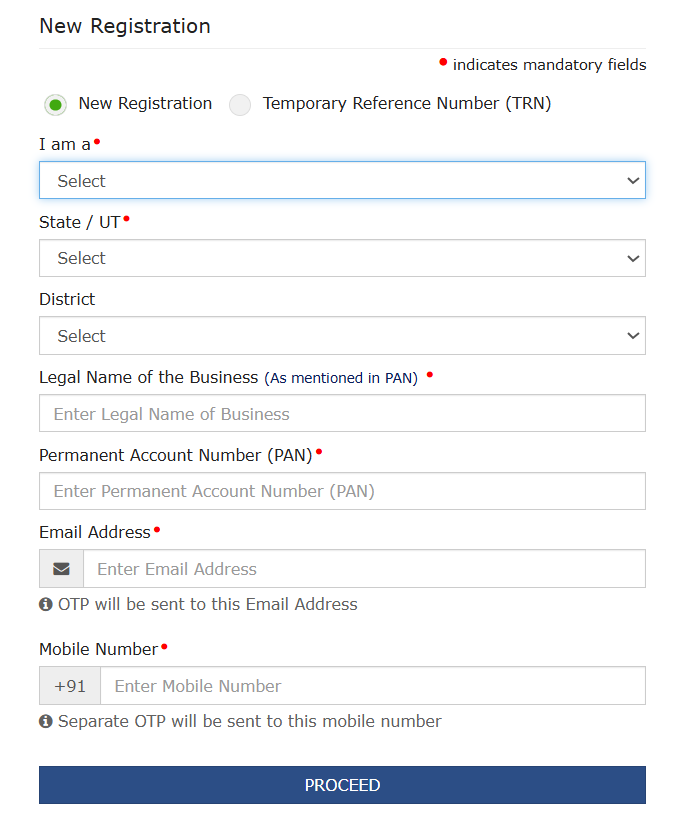
You will get to watch the screen as mentioned here, fill the details asked here to proceed when you dont have TRN already

Select whether you are  Taxpayer, Input Service Distributor(ISD), Tax Deductor, Tax Collector (Ecommerce Operators), Non Resident Taxable Person, GST Practitioner, or else.

Also, mention your legal name as per Permanent Account Number (PAN) only, Business Name can be differ.

Mention your email Address and Mobile number for OTP and all future correspondence with the GST Department. Make sure to provide active email and mobile number.

And after filling all the details and information here, Click on Proceed to reach the next page.

Step 3

You will receive a page to enter a valid OTP, here Email and Mobile OTP will be the same. You can check and mention any of them to proceed.

Step 4

Once the OTP you entered above verified and approved, you will get this Screen, where TRN (Temporary Reference Number) will be mentioned for you. 

Save the TRN and write it down to your notepad for future correspondence. You will also get the said TRN through the text in messages and in your email mentioned in the application.

Step 5

Now, you have TRN with you to proceed for GST Registration. You must know that TRN will be available for 15 days to complete the process with the same TRN. Otherwise, a new TRN will be required.

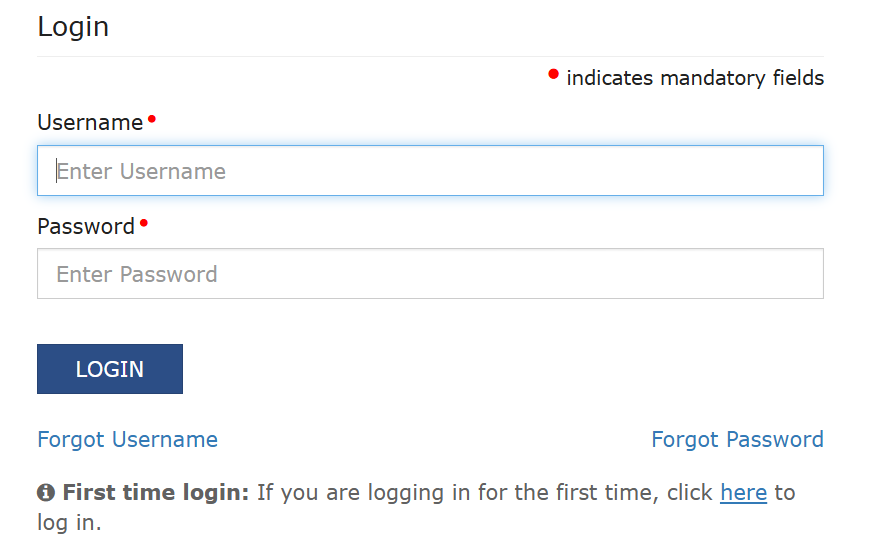
Now you will login the Portal with your Received TRN and OTP to be received through your email and mobile both. After entering the OTP, you will be reached at a page where your Draft application is being shown.

Step 6

Here, you must complete this draft application within 15 days from generating the TRN. Till the date you didn’t get a GST Number from the GST Department, you can login with TRN for your registration.

Step 7

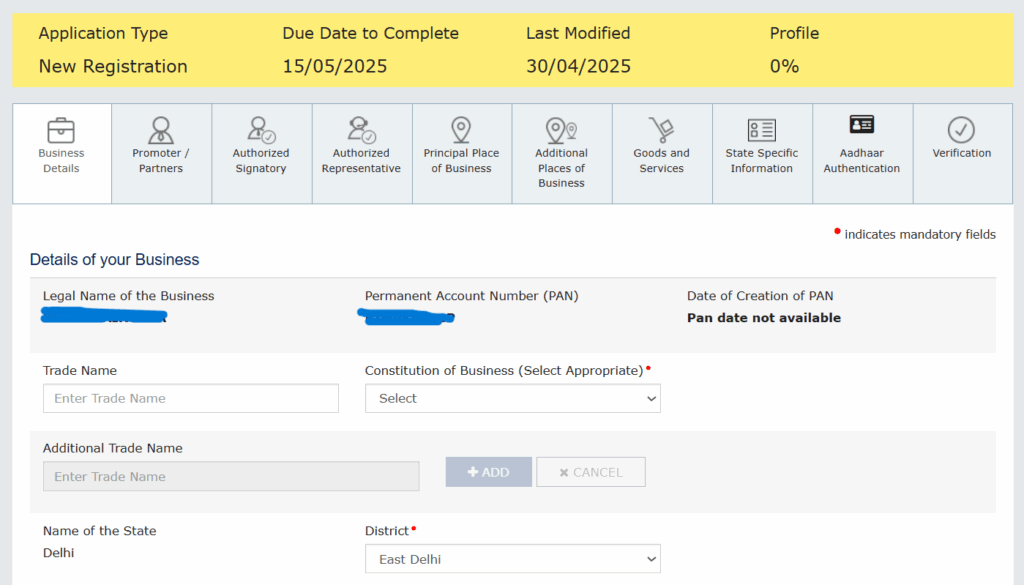
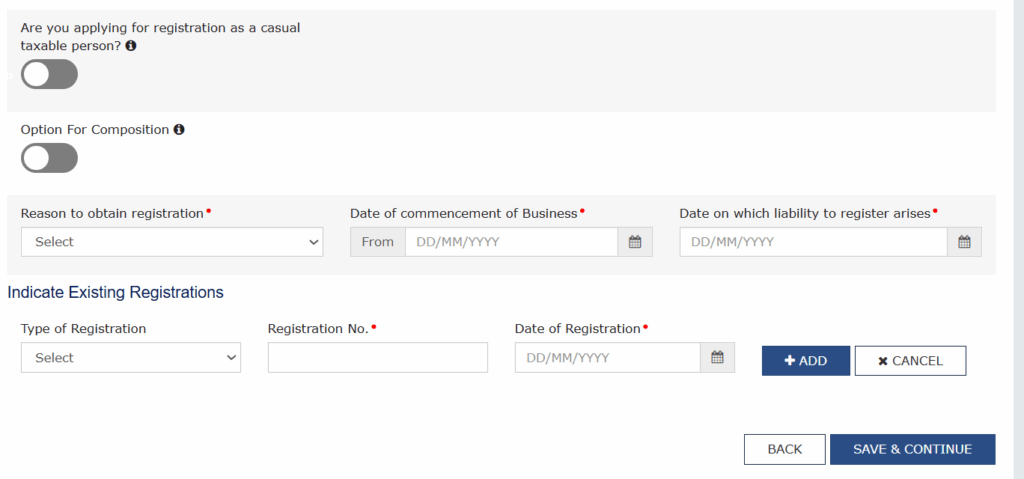
Here, you must provide Trade Name of business, Address details and proof of premise where the business is being operated, Personal details of Proprietor/Partners/Directors, Documentary proof of any additional premise for business to be attached, and all the details asked in the draft form must be provided. 

Here in the image, this is only first page of the draft form. The Applicant must complete the entire draft application, then Profile completion % mentioned in the right side of the image will be shown as 100%

Step 8

Aadhaar Authentication process

After the completion of the draft form, verification process is being done according to rules and provisions. There is an option to do Aadhaar Authentication with biometric verification of the primary authorized person. Where the mobile number of the primary responsible person used for registration is the same number with which Aadhaar has been linked, it is possible to authenticate the Aadhaar online with OTP. It cuts the time process of approval from the department within 7 days. 

Also, where a person opts to not to authenticate Aadhaar as described here before, he/she  can upload an Aadhaar copy to complete the KYC process. In such case, the GST Officer must verify the principal place of business physically and the time limit to approve the GST Registration Application is within 30 days.

It is advisable and beneficial to do Aadhaar authentication with biometric verification for GST Registration.

Step 9 

Approval of GST Application

Once the department is satisfied with all the details mentioned here and documents attached, the application will be approved. The applicant will receive an automatically sent mail having the login credentials in it.

Login path for First time users must be used, Here, Create the User Id ( not changeable) and change the system password given by the department through the mail.

Step 10 

Bank Account Update

Generally people thinks GSTN is received and work is done. But, this is untrue. The registered taxpayer must add their bank details with a cancel cheque or bank passbook first page mandatorily within 45 days from the date of registration granted.

In case of non compliance, the department can cancel the GST Registration after the deadline passed.

About Author – Deepa Kaintura

I am a lawyer by profession. I am a legal consultant in TaxAcumen providing services to corporates about GST, Income Tax, ROC Compliances, etc. My love for finance and law encouraged me to write and share the knowledge with the readers here. For any query, reach us at 

WhatsApp : +91-9267970588 Email I’d:taxacumen.consultancy@gmail.com

Appointment of Directors – Provisions and Procedure for Private Limited

A company registered under Company Act, 2013 with MCA needs to ensure proper compliances as per the relevant said law. A company is a legal entity which needs a board of directors to operate its functions. A board of directors implies a group of individuals who are entrusted with the management of the company.

At the time of incorporation, a Private Limited is required to appointment a minimum of two directors. In case of no appointment made, all the subscribers to memorandum will be considered as first directors. After Incorporation, in case there is a need to appoint a director, the proper procedure needs to be followed.

Prerequisite for the appointment of a director 

  1. A person proposed to be appointed as director, must have a Director Identification Number (known as DIN) and a valid DSC to sign the MCA Forms;
  1. The person proposed to be appointed as Director must submit the form DIR 2 to give the consent for appointment and declare that he is not disqualified to be appointed as director in the company;

The eligibility to become a director in the company is as follows:

  1. The proposed person must be above 21 of age;
  2. The individual must be of sound mind;
  3. An undischarged bankrupt or adjudged insolvent should not be appointed;
  4. A person sentenced and convicted by court for more than six months is not eligible to become a director.

Documents required for appointment:

  1. A copy of valid PAN copy 
  2. A copy of Identity proof, such as Aadhaar, Voter Id, Passport, etc.
  3. Passport Size Photo
  4. Digital Signature Certificate (DSC)

During Incorporation process, the person to be appointed must have obtained DSC for sign the Form to subscribe and mention PAN for the process. A DIN will be allotted directly and no diferent form is required to sign or to apply.

And in case of Appointment after the incorporation, the procedure is required to be followed, which is as follows:

  1. Firstly,check the AOA of the company to ensure that the appointment must be within the limit of Articles. If required, alter the Articles of Association for the same.
  1. The proposed person must obtain a valid DSC.
  1. The person proposed, if they don’t have a valid DIN, must apply the same with the Form DIR 3. Also refer the article on Allotment of DIN here https://taxacumen.in/?p=349
  1. The proposed person must intimate the Company about his/her active DIN for further process.
  1. Also, Submit the consent to act as a director and declare that there is no disqualification to him/her to appointment in DIR 2. No person can be appointed as director unless he/she submits the consent to act as director.
  1. The proposed person must intimate the company about his/her interest in other entities. 
  1. The appointment of directors takes place in a General Meeting by the shareholders. In case an appointment is being made in between the AGMs, the company can call an Extra General Meeting(EGM) for the purpose. Also, the additional director can be appointed by the directors in the Board Meeting only, if empowered in the AOA. The additional director can be appointed till the next AGM to be held.
  1. The company must provide an appointment letter to the person appointed.
  1. The company must file the FORM DIR 12 with ROC within 30 days from the event.

The article here is based on the provisions and procedure provided under the Company Act, 2013 in general language. 

For the professional advice, one can reach to us: 

WhatsApp : +91-9267970588

Email I’d   : taxacumen.consultancy@gmail.com

Follow our Whatsapp Channel 

https://www.whatsapp.com/channel/0029VaXqUTnL2AU3Z1yxXD3S

Follow our Instagram Channel 

https://www.instagram.com/taxacumen.20/?next=%2Fthelegalarena%2F

About Author – Deepa Kaintura

I am a lawyer by profession. I am a legal consultant in TaxAcumen providing services to corporates about GST, Income Tax, ROC Compliances, etc. My love for finance and law encouraged me to write and share the knowledge with the readers here.  

Allotment of Director Identification Number under the Companies Act, 2013 and Rules thereunder

Under the company Act, 2013, Section 153 to 159 are in relation to the allotment of Director Identification Number (commonly known as DIN) to Director and conditions to be satisfied for the same and penalty for Non-compliance.

Section 153 states that

“Every individual who is intended to become a director needs to apply for DIN. Application to be made in the form DIR-3 to the Central Government (CG) along with the prescribed fees (presently fees is 500 for each application)

Procedure to Apply for DIN

The following documents need to be uploaded while applying DIN:

  1. Photograph
  2. Proof of Identity
  3. Proof of residence
  4. Verification of Signature specimen (Optional)

The form DIR-03 is to be digitally signed along with the applicant by 

A Chartered Accountant in practice; or

Company Secretary in practice; or

CMA in practice; or 

Managing Director or Director of the company in which applicant intended to be appointed; or

CS of the company in full time employment.

Section 154 states that the CG shall allot DIN within one month from the receipt of the application after due verification.

Conditions to be complied for Director Identification Number

There are also some conditions mentioned in relation to DIN under the above said Act which are as follows:

A Person can have only one DIN;

Every existing Director shall within one month of receiving the DIN, intimate to all the companies wherein he is a director;

Every company shall, within fifteen days of the receipt of DIN from the directors, furnish all the details to the Registrar;

Every company or directors, while furnishing any returns, information or particulars required under the Act, shall mention the DIN in the return, information or particulars relating to the said director.

Change in Particulars of the Directors – DIR-6 Form:

In case of any change in the particulars of the directors, the Form DIR-06 is to be submitted to intimate the changes such as change in address, or any other details.

Penalty/Punishment for Non-compliance

If any individual/ Director of a company, contravenes any provision, shall be punishable with the imprisonment for a term upto six months or with fine upto the limit of Fifty Thousands.

And it is also stated that in case of continuing Non-compliance, punishment can be extended with a further fine upto Five hundered for every day after the first contravention.

Also if any company contravenes the requirement of furnishing DIN of the directors or other officers under section 157, the company shall be punishable with the fine which is not less than Twenty thousands, but may extend upto one lakh rupees, and 

Every officer-in default of the company shall also be punishable with fine which shall not be less than twenty five thousands, but may extend upto one lakh rupees.

For the professional advice, one can reach to us: 

WhatsApp : +91-9267970588

Email I’d   : taxacumen.consultancy@gmail.com

Follow our Whatsapp Channel 

https://www.whatsapp.com/channel/0029VaXqUTnL2AU3Z1yxXD3S

Follow our Instagram Channel

https://www.instagram.com/taxacumen.20/?next=%2Fthelegalarena%2F 

About Author – Deepa Kaintura

I am a lawyer by profession. I am a legal consultant in TaxAcumen providing services to corporates about GST, Income Tax, ROC Compliances, etc. My love for finance and law encouraged me to write and share the knowledge with the readers here.