CAPITAL GAINS TAX IN INDIA – TYPES, TAX RATES & EXEMPTIONS

Capital Gains Tax is a tax imposed on the profits made when a capital asset (capital asset, i.e., property, stock, mutual funds, gold, etc.) is disposed of. Capital gains tax is a significant component of taxation and the tax system in India, affecting both investors and property owners.

The calculation, tax rates and exemptions for capital gains are based on how long the asset is held prior to its disposal. It is important for taxpayers to remain aware of their legal obligations because the budgets presented in Budget 2024 altered a number of capital gains tax rates, indexation, and asset types.

Types of Capital Gains

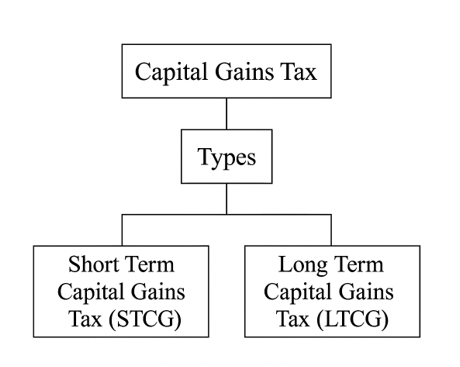
The types of capital gains are based on how long the asset is held before disposal. Typically, these are classified as 2 types:

Short-Term Capital Gains (STCG)

Short-Term Capital gains apply when the asset is sold in a short amount of time. The holding period depends on how the asset is held:

  • For listed shares and equity mutual funds, where sold in 12 months
  • For unlisted shares and properties, where sold in 24 months
  • For other assets, such as gold, bonds, etc., which were sold in 36 months

Compared to long-term gains, the tax rate on profits from such sales is higher. Recent changes have raised the STCG tax rates for mutual fund redemptions and listed equity shares in an attempt to prevent speculation and short-term trading.

Long-Term Capital Gains (LTCG)

If the asset is held over and beyond the short-term thresholds discussed above, any profit on the sale of the asset would be treated as a long-term capital gain. The holding periods are:

  • Over 12 months for listed equity shares and mutual funds
  • Over 24 months for unlisted shares and immovable property
  • Over 36 months for all other assets

LTCG will generally be taxed at lower rates than STCG. The only disadvantage is that for the sale of most assets, indexation will be eliminated for sales after July 23, 2024.

Capital Gains Tax Rates (FY 2025–26)

The tax rates that apply are shown below:

Asset Type  Holding PeriodTax Rate
Listed Equity Shares & Equity Mutual Funds  Short-Term (≤ 12 months)20% (previously 15%)
 Long-Term (> 12 months)12.5% on amounts above ₹1.25 lakh  
Unlisted Shares & Real EstateShort-Term (≤ 24 months)  Taxed as per slab
 Long-Term (> 24 months)  12.5% without indexation
Gold, Bonds, Debentures, Other AssetsShort-Term (≤ 36 months)Taxed as per slab
 Long-Term (> 36 months)  12.5% without indexation

Note: Because most long-term assets were sold after July 23, 2024, indexation has been removed.

Exemptions on Capital Gains Tax

The Income Tax Act has exemptions for reinvestment of capital gains in certain sections:

Section 54: Exemption on the sale of residential property if reinvested in another house.

Section 54F: Exemption on the sale of any long-term capital asset if the sale profits are reinvested in a house.

Section 54EC: Exemption allowed if the profits are invested in specified bonds within 6 months of sale.

The Capital Gains Account Scheme (CGAS) can be used to temporarily store the sale profits in case immediate reinvestment is not possible.

Conclusion

Capital Gains Tax (CGT) plays a vital role in wealth management and decision-making in investing. It is critical to understand the difference between short-term capital gains and long-term capital gains so tax liabilities can be planned accordingly.

With the recent tax changes, some careful investment planning and holding periods beyond short-term assets and all the exemptions as per the new laws may reduce tax liability.
Types of Direct Tax

A Direct Tax is one that is levied upon a person or entity and paid to the government directly. It is impossible to transfer the tax burden to another person.

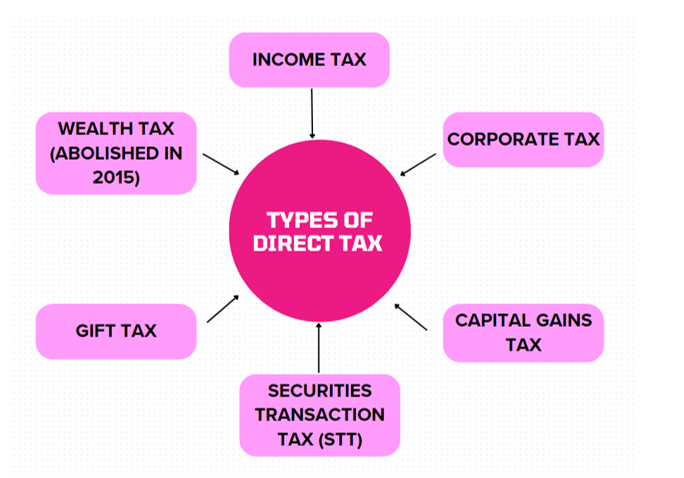
These are few types of direct tax:

Income Tax (IT)

According to the provisions of the Income Tax Act of 1961, income tax is a tax that is directly imposed on the earnings that individuals, Hindu Undivided Families (HUFs), businesses, limited liability partnerships (LLPs), enterprises, and other entities earn. Five categories are used to categorise the Income: Capital Gains, Profits and Earnings from Business or Profession, Income from House Property, Income from Salaries, and Income from Other Sources. After calculating the relevant deductions and exemptions (such as those provided by Sections 80C, 80D, etc.), tax is due on the total taxable income. Through the Finance Act, the government updates tax rates and slabs every year (Union Budget). The Government of India receives most of its revenue from income tax.

Corporate Tax

According to the Income Tax Act of 1961, Corporate tax is imposed on the net profit of businesses, both local and foreign. While international corporations are only taxed on their income made in India, domestic companies are taxed on their entire income. Under Sections 115BAA and 115BAB, businesses may choose to use concessional rates, subject to specific requirements. Companies may also be required to pay health and education cess and surcharges in addition to corporate tax. India’s revenue is largely derived from corporate taxes, particularly from big businesses in industries like manufacturing, finance, and information technology.

Capital Gains Tax

When Capital Assets, such as buildings, land, gold, shares, and other valuable property, are sold or transferred, the profits are subject to capital gains tax. It is divided into two categories according to the period of time the asset is held: Short-Term Capital Gains (STCG) and Long-Term Capital Gains (LTCG). Depending on the asset type and holding duration, the tax rate changes.

Securities Transaction Tax (STT)

The Securities Transaction Tax (STT) is a direct tax levied on securities-related transactions carried out on authorised stock exchanges, including the buying and selling of shares, derivatives, and equity-orientated mutual funds. In order to streamline the taxes of stock market transactions, it was created by the Finance Act of 2004. Different transaction types have different STT rates. Depending on the nature of the transaction, the buyer, seller, or both may be responsible for paying the tax, which is collected by stock exchanges.

Gift Tax

The 1958 Gift Tax Act served as the original legislation governing gift tax; however, it was repealed in 1998. Gift taxation is now regulated under Section 56(2)(x) of the Income Tax Act of 1961. The amount of gifts given to an individual or HUF in a fiscal year that exceed ₹50,000 in value (apart from certain relatives or exempt categories) is taxed as income from other sources. Some presents, including those given as a marriage present or as an inheritance, are still excluded.

Wealth Tax (Abolished)

A direct tax referred to as wealth tax was imposed on the net worth of specific people, HUFs, and businesses if it beyond the specified amount. It was regulated by the 1957 Wealth Tax Act. Real estate, gold, expensive cars, and jewellery were all subject to wealth tax. The Finance Act of 2015 eliminated wealth tax for the Assessment Year 2016–17 due to the high expenses of compliance and low revenue yield. However, in order to maintain transparency and stop tax evasion, high-value assets are still required to be reported on income tax returns.