How to Claim Input Tax Credit (ITC) in GST

Understanding the Input Tax Credit (ITC) under the Goods and Services Tax (GST) is important for businesses in order to reduce the tax burden. In order to prevent a cascade of taxes and cash flow restrictions, ITC makes sure that taxes are only applied to the value produced by goods at each level of the supply chain, rather than the combined value. Although claiming input tax credits is a straightforward idea, it does need timely return submission, documented verification, and compliance with and awareness of GST requirements.

What is Input Tax Credit (ITC)?

Input Tax Credit means that the GST paid on purchases or expenditures in the course of one’s business can be deducted against the GST expected to be collected on sales. ITC ensures that tax is payable only on the final value and prevents double taxation of the tax and value addition given to the services or products offered.

Example:

  • You purchase raw materials worth ₹1,00,000 and pay ₹10,000 as GST.
  • You sell finished goods worth ₹1,50,000 and collect ₹15,000 as GST.
  • You can claim ITC of ₹10,000, which means you only pay ₹5,000 GST payable net.

So, ITC reduces tax liability and improves working capital efficiency.

Conditions to Claim ITC

A registered person under GST can claim ITC only when the following conditions are satisfied:

  • The claimant must be registered under GST.
  • Possession of a valid tax invoice or a debit note from a registered supplier.
  • Goods or services are received.
  • The supplier must pay GST to the government.
  • The recipient must file a monthly GST return (GSTR-3B).
  • Payment to the supplier must be made within 180 days from the invoice date.
  • If the goods are received in instalments, ITC can be claimed only after the last lot is received.
  • ITC can only be claimed for a business purpose; personal purchases are not covered.
  • No ITC is permitted if depreciation has been claimed on the GST portion of capital assets.

ITC must also be claimed before:

  • 30th November of the next financial year, or
  • the date of filing the annual return, whichever is earlier.

Provisional ITC (i.e., claiming ITC without the supply having been reported in GSTR-1) was not required to be reported from January 2022.

How to Claim ITC?

The steps of claiming ITC under GST are as follows:

1. Reconciliation of Purchases Data

Match the purchase register with the GSTR-2B containing the invoice details as claimed by the supplier.

2. Verification of documents

Make sure that the tax invoices are valid and the supplier has complied with the GSTR-1 return filing.

3. GSTR-3B filing

In Table 4 of GSTR-3B returns, the eligible ITC, ineligible ITC, reversals and reclaims should all be declared.

4. Reverse Ineligible ITC

If the ITC is no longer available under Section 17(5) of the CGST Act or not claimed through GSTR-2B, then reverse the ITC when filing the GSTR-3B to avoid penalties down the line.

5. Proper Documentation

Keep all relevant invoices, debit notes, bills of entry and documentation if there was an ISD arrangement, all organised properly according to which audit/inspection that you might be facing.

Nowadays, companies use electronic tools that help them match GSTR-2B with purchase registers more accurately, increasing their chances of claiming ITC with minimal manual error or tax department enquiries.

When ITC Cannot Be Claimed

Under Section 17(5) of the CGST Act, businesses can find restrictions on ITC in the following circumstances:

  • Goods or services that are used for personal consumption.
  • Exempt supplies (i.e., supplies that are not taxable under GST).

The items specifically:

  • A motor vehicle when used for personal purposes.
  • Food, beverages, and club memberships (except if required by law).
  • Health or life insurance (except if required by law).
  • Construction of immovable property (i.e., building or office).
  • Goods that have been lost, stolen, destroyed, or gifted.

Conclusion

Businesses that claim ITC under the GST have lower tax liabilities and better cash flow. However, if you wish to claim ITC, you must properly comply with ITC requirements and record and verify purchase data linked to GSTR-2B.

Companies are required to pay their suppliers on schedule and in accordance with GST regulations. In order to comply, businesses must also reverse ineligible ITC. Businesses may prevent errors, receive the full advantages of the ITC, and avoid penalties from tax authorities by using technology and automation to assist them in claiming the credit.
TYPES OF GST in India – Brief Discussion

Goods and Services Tax (GST) is a form of indirect tax levied on the supply of goods and services in India. This multi-stage tax is at every stage of the supply chain, with the advantage of Input Tax Credit (ITC) at every stage. The current structure is transparent and uniform in taxation across states and avoids the cascading effect of taxes.

The central aim of GST is to support the concept of “One Nation, One Tax” through simplification and streamlining of India’s indirect taxation system.

Central Goods and Services Tax (CGST)

Central Goods and Services Tax (CGST) is imposed by the central government through the CGST Act, 2017. It is payable on all intrastate supplies of goods and services—i.e., where both the supplier and recipient are within the same state or union territory.

CGST is levied with SGST or UTGST on the very same taxable supply. The overall GST rate is divided evenly between the State and the Centre. For instance, if a commodity is taxed at 18%, then 9% is CGST and 9% is SGST. The CGST amount goes into the account of the central government and is utilised for national-level spending such as infrastructure, defence, and centrally sponsored schemes.

The central government allows input tax credits of CGST on acquisitions, which can be utilised to offset CGST or IGST liability but not SGST.

State Goods and Services Tax (SGST)

State Goods and Services Tax (SGST) is charged by the state governments under their respective SGST Acts, which have been enacted in line with the central GST structure. SGST is also charged in intra-state transactions and is levied by the state on which consumption takes place.

The state government involved receives the revenue from SGST. Similar to CGST, the SGST share of a transaction typically accounts for 50% of the overall GST. These revenues are utilised to fund state-level development like education, healthcare, infrastructure, and welfare schemes.

SGST paid as input tax can be utilised to set off SGST or IGST (in certain situations), but not CGST, which assists in keeping the revenues of states and the centre free from mutual dependence.

Illustration: A restaurant business in West Bengal offers services amounting to ₹10,000. If GST is 18%, ₹900 is CGST and ₹900 is SGST.

Union Territory Goods and Services Tax (UTGST)

Union Territory Goods and Services Tax (UTGST) is charged on intra-state supplies made within Union Territories (UTs) that lack legislatures. It is administered under the UTGST Act, 2017, and is payable in the following UTs:

  • Andaman and Nicobar Islands
  • Lakshadweep
  • Chandigarh
  • Dadra and Nagar Haveli and Daman and Diu
  • Ladakh

In such regions, UTGST substitutes for SGST and is charged together with CGST. Both might be collected by the central government, but UTGST is separately credited to an account from CGST.

Similar to what occurs in SGST, the total GST is divided equally—e.g., CGST 9% and UTGST 9% for an 18% GST rate.

Note: UTs having their own legislature, i.e., Delhi, Jammu & Kashmir, and Puducherry, are not covered under UTGST. In such cases, SGST is charged in lieu.

Integrated Goods and Services Tax (IGST)

Integrated Goods and Services Tax (IGST) is charged by the Central Government under the IGST Act, 2017, and is levied on:

  • Inter-state transactions (from one state or UT to another state or UT)
  • Import of goods or services into India
  • Export of Indian goods or services
  • Supply to or by Special Economic Zones (SEZs)

IGST replaces the previous Central Sales Tax (CST) and follows a destination-based taxation system. That is, tax is levied and paid in the state where the goods or services are consumed, rather than where they are manufactured.

In interstate transactions, the seller levies IGST, which is paid to the central government. The Centre then remits the due share to the destination state where the services or goods are ultimately consumed.

Illustration:

A supplier in Maharashtra supplies goods to a customer in Haryana for ₹1,00,000 at 18% GST. The supplier collects ₹18,000 as IGST and remits the same to the Centre. The Centre subsequently adjusts Haryana’s share accordingly.

Yet another advantage of IGST is the cross-utilisation of the credit of input tax. IGST credit may be utilised to discharge IGST, CGST, or SGST, hence being extremely flexible and important for the free flow of credit and to avoid tax cascading.

Types of Indirect Tax

An indirect tax is one that is levied on the consumption of goods and services. It is not applied immediately to a person’s earnings. Instead, the seller must pay the tax in addition to the price of the goods or services they bought. An indirect tax is collected and paid to the government by an individual in the supply chain, such as a manufacturer or retailer.

However, when a customer buys a good or service, the producer or retailer incorporates the tax in the price. The buyer ultimately pays the tax by increasing the product’s price.

The indirect tax structure in India can be better understood by looking at the following list of indirect taxes:

Goods and Services Tax (GST)

One of the most significant reforms in India’s tax structure, GST, or Goods and Services Tax, has replaced many older levies that once fell under different types of indirect taxes. Introduced on July 1, 2017, GST consolidated multiple state and central taxes into a single tax applied to the supply of goods and services across the country.

GST is structured to promote transparency and remove the cascading effect of tax-on-tax. It is applicable at every stage of the supply chain, right from the manufacturer to the end consumer. The tax you pay is divided among different authorities based on the nature of the transaction:

  • Central Goods and Services Tax (CGST): Collected by the central government on intra-state sales (within the same state).
  • State Goods and Services Tax (SGST): Collected by the state government on intra-state sales.
  • Integrated Goods and Services Tax (IGST): Collected by the central government on inter-state transactions (between different states).
  • Union Territory Goods and Services Tax (UTGST): Applied in Union Territories where SGST does not apply.

Different slabs of GST rates—0%, 5%, 12%, 18%, and 28%—are distinguished based on the goods or services being offered. The majority of consumer products and services are between 5% and 28%, apart from certain requirements.

GST has made it easier for businesses to comply with the tax system and guaranteed that you, as a consumer, pay a more efficient and transparent tax.

Customs Duty

According to the Customs Act of 1962, customs duty is a tax levied on the import and export of commodities. Basic customs duty, countervailing duty, and anti-dumping duty are some of its constituent parts. In addition of generating money, customs taxes also aid in controlling international trade and safeguarding local businesses.

Excise duty

Previously a significant indirect tax on Indian manufacturing, excise duty is now only applied to specific goods including alcohol, tobacco, and petroleum products. Other products are now subject to the GST system. The central government and state governments in these exempted categories still rely heavily on excise duty as a source of funding.

Value Added Tax (VAT) and Sales Tax

Value Added Tax (VAT) and Sales Tax were the two main state-level taxes on the sale of products prior to the introduction of the Goods and Services Tax (GST). VAT still applies to petroleum items and alcoholic drinks, which are exempt from the GST structure because of constitutional requirements, even though the GST has replaced them for the majority of goods.

Stamp Duty

State governments impose stamp duty, a tax, on a variety of legal documents, including agreements, sale transactions, and property transfers. Stamp duty is a separate fee on transactions involving immovable property and is not included in the GST. It is governed by the Indian Stamp Act, 1899, and the legislation of the respective states.

Entertainment Tax

Now mostly incorporated into GST, the entertainment tax was previously imposed by state governments on services including cable TV, amusement parks, and movie tickets. It may still be applied to certain entertainment services that are not included by the GST system, however, by certain states and local governments.

GST REGISTRATION PROCESS in INDIA

Any person falling under the laws of GST must need to get registered under the GST and have the GSTN. Click the link here to know, whether you are falling within limit GST registration threshold limit, https://taxacumen.in/?p=978 and to understand the benefits of the same https://taxacumen.in/?p=986

Here, we will not discuss again whether you are required to have GST or not, but to know step-by-step registration process to apply for the same.

Step 1

Go to the Website https://www.gst.gov.in/ and to register, go to the “Register” tab on the Right side in Top location. If you are here for the first time go to “New Registration” and if you already have TRN, Click to TRN.

Step 2

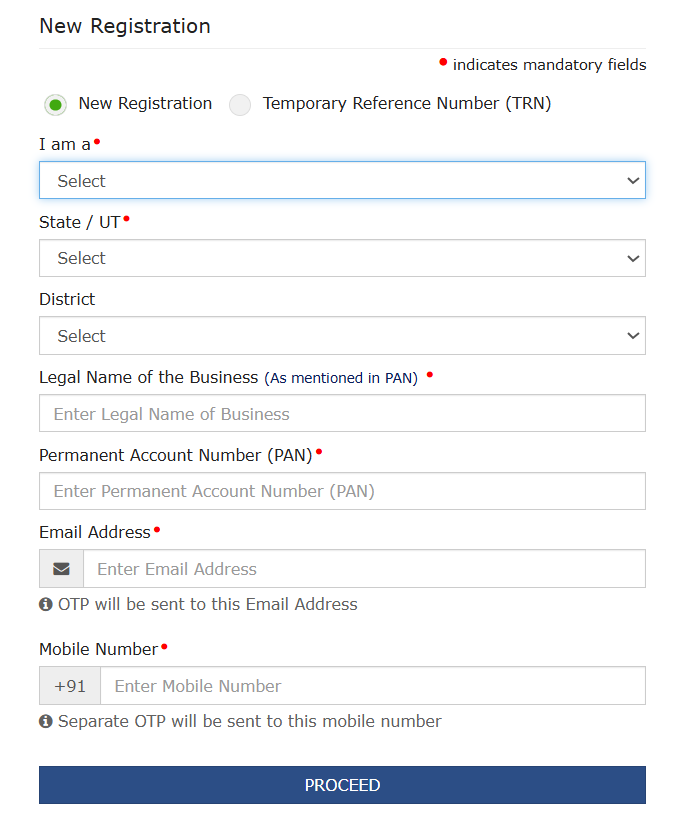
You will get to watch the screen as mentioned here, fill the details asked here to proceed when you dont have TRN already

Select whether you are  Taxpayer, Input Service Distributor(ISD), Tax Deductor, Tax Collector (Ecommerce Operators), Non Resident Taxable Person, GST Practitioner, or else.

Also, mention your legal name as per Permanent Account Number (PAN) only, Business Name can be differ.

Mention your email Address and Mobile number for OTP and all future correspondence with the GST Department. Make sure to provide active email and mobile number.

And after filling all the details and information here, Click on Proceed to reach the next page.

Step 3

You will receive a page to enter a valid OTP, here Email and Mobile OTP will be the same. You can check and mention any of them to proceed.

Step 4

Once the OTP you entered above verified and approved, you will get this Screen, where TRN (Temporary Reference Number) will be mentioned for you. 

Save the TRN and write it down to your notepad for future correspondence. You will also get the said TRN through the text in messages and in your email mentioned in the application.

Step 5

Now, you have TRN with you to proceed for GST Registration. You must know that TRN will be available for 15 days to complete the process with the same TRN. Otherwise, a new TRN will be required.

Now you will login the Portal with your Received TRN and OTP to be received through your email and mobile both. After entering the OTP, you will be reached at a page where your Draft application is being shown.

Step 6

Here, you must complete this draft application within 15 days from generating the TRN. Till the date you didn’t get a GST Number from the GST Department, you can login with TRN for your registration.

Step 7

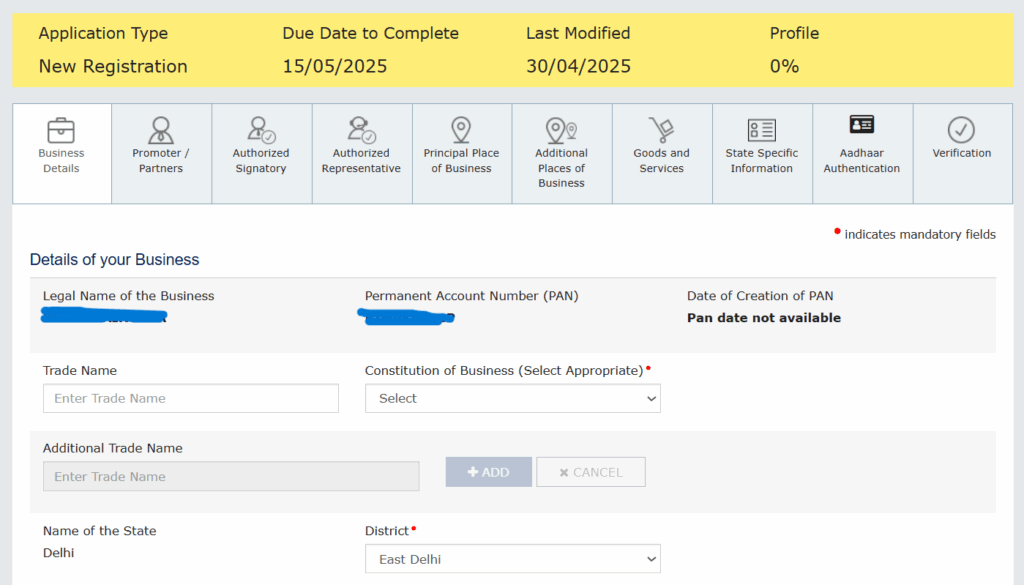
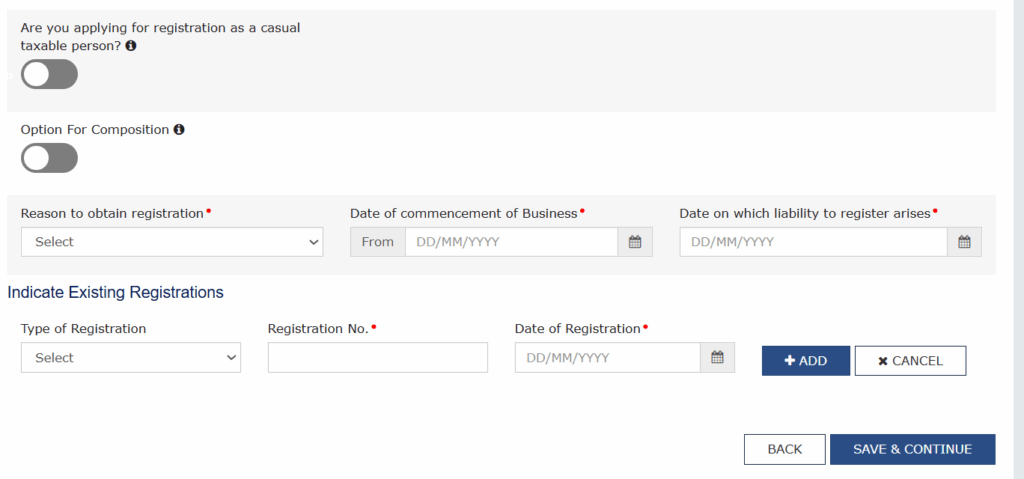
Here, you must provide Trade Name of business, Address details and proof of premise where the business is being operated, Personal details of Proprietor/Partners/Directors, Documentary proof of any additional premise for business to be attached, and all the details asked in the draft form must be provided. 

Here in the image, this is only first page of the draft form. The Applicant must complete the entire draft application, then Profile completion % mentioned in the right side of the image will be shown as 100%

Step 8

Aadhaar Authentication process

After the completion of the draft form, verification process is being done according to rules and provisions. There is an option to do Aadhaar Authentication with biometric verification of the primary authorized person. Where the mobile number of the primary responsible person used for registration is the same number with which Aadhaar has been linked, it is possible to authenticate the Aadhaar online with OTP. It cuts the time process of approval from the department within 7 days. 

Also, where a person opts to not to authenticate Aadhaar as described here before, he/she  can upload an Aadhaar copy to complete the KYC process. In such case, the GST Officer must verify the principal place of business physically and the time limit to approve the GST Registration Application is within 30 days.

It is advisable and beneficial to do Aadhaar authentication with biometric verification for GST Registration.

Step 9 

Approval of GST Application

Once the department is satisfied with all the details mentioned here and documents attached, the application will be approved. The applicant will receive an automatically sent mail having the login credentials in it.

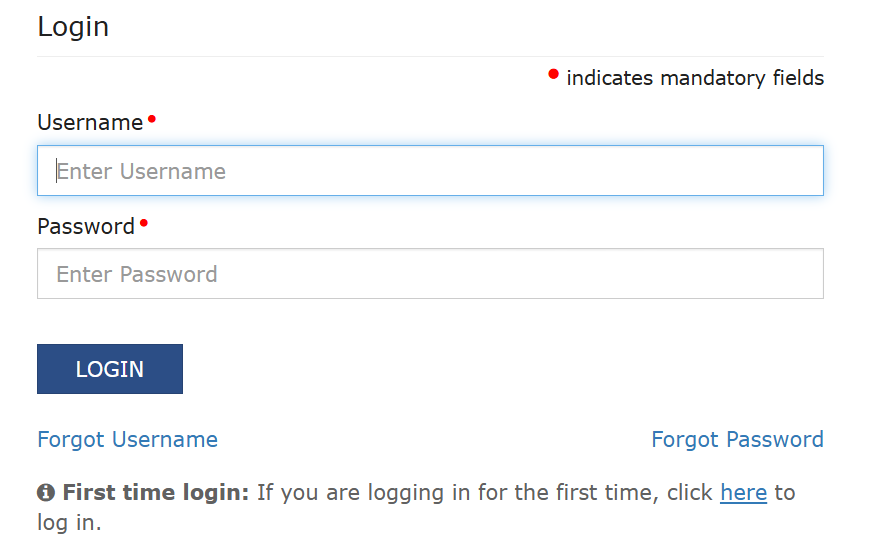
Login path for First time users must be used, Here, Create the User Id ( not changeable) and change the system password given by the department through the mail.

Step 10 

Bank Account Update

Generally people thinks GSTN is received and work is done. But, this is untrue. The registered taxpayer must add their bank details with a cancel cheque or bank passbook first page mandatorily within 45 days from the date of registration granted.

In case of non compliance, the department can cancel the GST Registration after the deadline passed.

About Author – Deepa Kaintura

I am a lawyer by profession. I am a legal consultant in TaxAcumen providing services to corporates about GST, Income Tax, ROC Compliances, etc. My love for finance and law encouraged me to write and share the knowledge with the readers here. For any query, reach us at 

WhatsApp : +91-9267970588 Email I’d:taxacumen.consultancy@gmail.com

BENEFITS OF GST REGISTRATION IN INDIA 

In GST (Goods and Service Tax) Laws, GST Registration is not required to be done for all the people who are engaged in some kind of business and other activities. 

In General, GST Registration is considered as a primary requirement for doing the business, but this is not the case. To know more about and check the applicability and threshold concept in GST Law, Click here https://taxacumen.in/?p=978

There are many activities which are not to be taxed under GST and also, there is an exemption to register according to threshold limit and place of business. 

In spite of the threshold limit, any business entity can voluntarily get itself registered under the GST Laws but once it gets registered, all the provisions, rules and regulations are binding upon and must be complied with.

Here, we will talk about the benefits of getting a GST Number whether or not, taken voluntarily or in other cases.

BENEFITS OF GST Registration in India

  1. Availability of ITC Claim for Tax Payer

A business who pays GST on input services and goods, subject to  availability as per law, can claim the said GST Paid as ITC ( Input Tax Credit). Without GST, the same GST Paid is to be added to the cost of operations and no ITC can be claimed. 

  1. Composition Scheme 

Small Business owners are being allowed to pay lower rates of GST and to be known as composite Dealers with some restrictions and some benefits as well. Small Business with Turnover upto 1.5 Crore / 75 lakhs, can get the benefit under this scheme. Not all documents are required to be maintained. But NO ITC is allowed to businesses using this scheme and they must not claim any ITC. Cash is to be paid for the same.

  1. Simplified Tax System

Before July 2017, business entities must comply and ensure proper documentation and working as per many indirect tax laws such as Excise law, Service tax, VAT, etc. But with the implementation of GST, many laws are merged with GST and now, only one law needs to be taken care of. 

Returns under respective laws were required to be filled, and it was a burden on the businesses and also added extra cost to them. But now, only GST returns and Tax payments are needed. 

  1. Elimination of Double Taxation

GST is based on the “Tax on value addition” concept.

For example, Mr. A Buys a bag for Rupees 1,000/- ( One thousand in words Only) and resell the same at Rupees 1,200/- (Twelve Hundred in words Only). He is required to pay 

GST on Purchase ( ITC) 18% on Rs 1000/- is Rs 180/- 

GST on sale (Outward supplies) on Rs 1200/- is Rs 216/-

New GST Payable after claiming ITC is Rs. 36/- ( Rupees Thirty Six in words only)

  1. Better Recognition in Market

Practically, in many instances it has been a positive remark where the party is being registered in the GST Law, whether he is under the threshold  limit for the registration. The Market feels more confident when dealing with a GST Registered person to have a transparent and more genuine transaction.

  1. Legal Recognition

A person can start doing the business with his own PAN only. There is no legal requirement to have any specific business registration in many cases. But when we practically go to open a bank account for business (current account), the Bank asks for a legal recognition certificate along with the GST Registration certificate. 

These are some benefits to get GST Registration even in case, you are falling under the threshold limit for exemption. One must consider all the factors together before deciding to have GST or not.

GST REGISTRATION – THRESHOLD LIMIT and APPLICABILITY

In this digital era, even a common man knows about the GST( Goods and Services Tax) by its name. Any person thinks of any idea for doing business, the first thing which strikes in his/her mind is that he/she must get the business registered under the GST Act.

But is it true that every business person needs to get registered for GST? Actually not.

Under the GST Act, the threshold limit is a very important term, which is the basis of registration requirement. Here, we will discuss the threshold limit applicable according to the provisions and rules. Threshold limit is decided based on the turnover as specified in the GST Law for the same.

Other than the business falling under the limit specified, there are a few other activities for which GST Registration is bound to be taken.

A person who is running a business or planning to start a business, must ensure whether he/she falls into the threshold limit to avoid the GST Registration till the limit meets or he/she is mandatorily required to get registered under GST laws as discussed below.

Threshold Limits are as specified under the Laws

Any person engaged in providing the services, where the aggregate turnover* exceeds Rs. 20 Lacs must get GSTN to do the business.

For special category states**, the above mentioned limit of Rs 20 Lacs to be considered as Rs 10 Lacs for checking the applicability.

Now, for the sale of goods within the same state, the threshold limit for states other than special category states, is Rs. 40 Lacs for intra state transactions. (Special category states** will be considered Rs. 20 Lacs)

* Aggregate Turnover means

The Aggregate Value of

  1. all taxable supplies (excluding inwards transactions chargeable on Reverse Charge Mechanism basis), 
  2. Exempt supplies
  3. Exports of goods or services or both
  4. Interstate supplies of persons with same PAN on all India basis, but, excluding the CGST, SGST, IGST, and cess.

** Special Category states mean the states of Arunachal Pradesh, Assam, Jammu and Kashmir, Manipur, Meghalaya, Meghalaya, Mizoram, Nagaland, Sikkim, Tripura, Himachal Pradesh and Uttarakhand.

The States/UTs had the option to choose the threshold limit to be considered for GST Registration. Accordingly, below mentioned states/UTs chose the limit for themselves.

States/UTs who considers the limit of Rs. 40 Lacs, are as mentioned below:

Kerala, Chhattisgarh, Jharkhand, Delhi, Bihar, Maharashtra, Andhra Pradesh, Gujarat, Haryana, Goa, Punjab, Uttar Pradesh, Himachal Pradesh, Karnataka, Madhya Pradesh, Odisha, Rajasthan, Tamil Nadu, West Bengal, Lakshadweep, Dadra and Nagar Haveli and Daman and Diu, Andaman and Nicobar Islands, Chandigarh, Jammu and Kashmir, Ladakh and Assam.

Telangana, being a normal and the only state, falls for the limit of Rs. 20/10 Lacs, as the case may.

States/UTs who considers the limit of Rs. 20 Lacs, are here mentioned:

Puducherry, Meghalaya, Mizoram, Tripura, Manipur, Sikkim, Nagaland, Arunachal Pradesh and Uttarakhand.

Now, other than the business entities that fall under the threshold limit specified above, a few business entities are mandatorily required to get registered under the GST Laws, which are as follows:

  1. Interstate Suppliers
  2. Casual taxable Persons
  3. Chargeable under Reverse Charge Mechanism
  4. Non Resident Taxable Person
  5. Persons required to deduct TDS under law
  6. Persons required to collect TCS under law
  7. Input Service Distributors
  8. E-Commerce Operator
  9. Persons making a sale on behalf of someone else whether as an Agent or Principal
  10. Providing OIDAR Services
  11. Suppliers who supply goods through e-commerce operators who are liable to collect tax at source.

It is also to be noted that any business entity does not fall under the threshold limit specified here, can also get registered under the GST voluntarily. But once the registration is done, all provisions and rules will be applicable on those who opted the same.